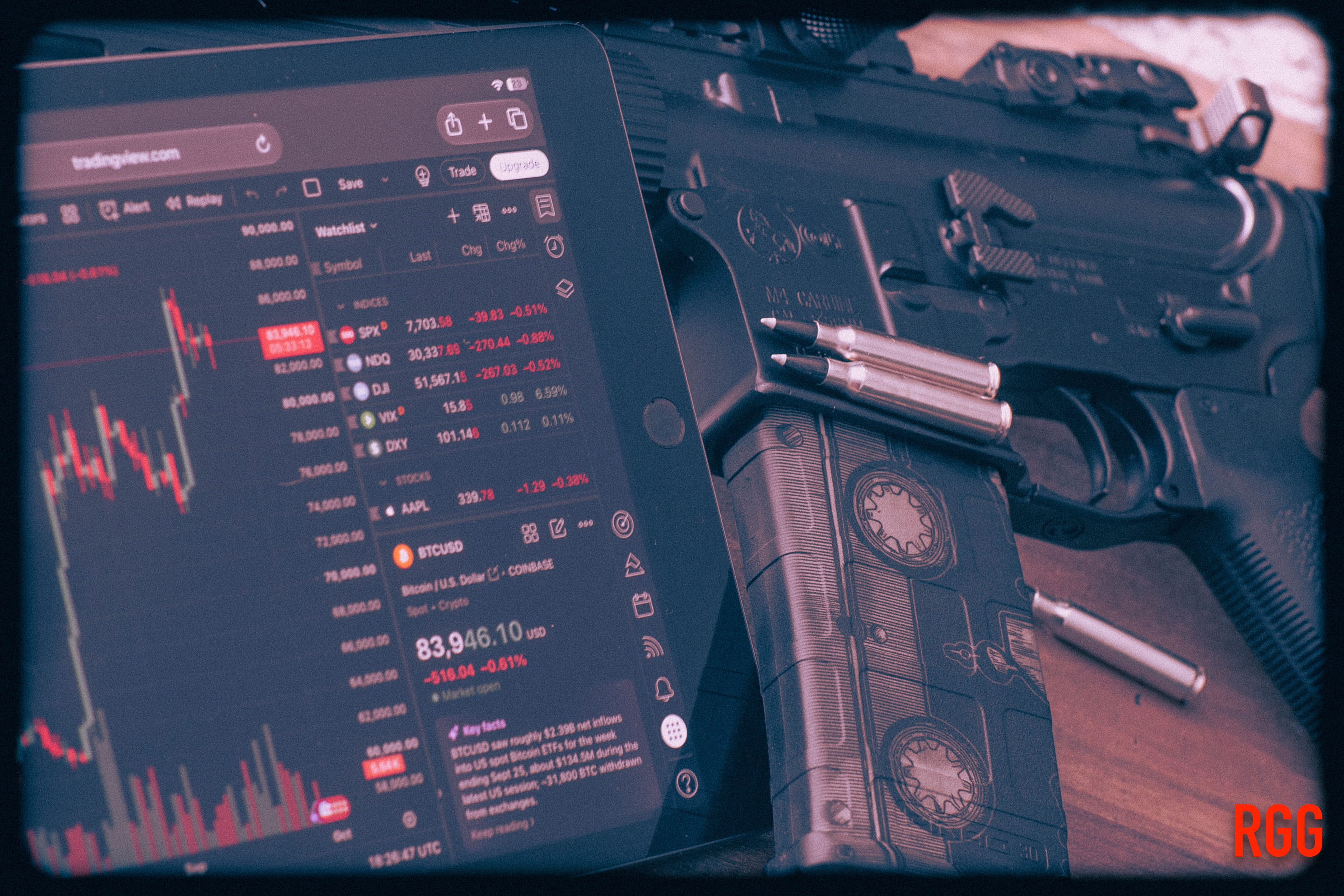
Shake out the doldrums and wake up, Second Amendment Radicals.
The people who cannot ban your rifle via law or via the courts have spent more than a decade trying to starve the shop that sells it. They do not need a new statute every time. They need a risk committee, a "reputational" memo, and a merchant category code. They need the card network that already knows you bought a case of 5.56 last Thursday. Then they wait for a charged political session, a leak, or a "public safety" task force that treats a lawful purchase history like probable cause.
This is not a thought experiment. It is the operating model.
In 2013 and 2014, the Department of Justice and federal bank regulators ran Operation Choke Point. The pitch was fraud prevention. The target list put lawful ammunition and firearms dealers in the same "high-risk" bucket as Ponzi schemes, altcoin rackets, and drug paraphernalia. Kat O'Connor of TomKat Ammunition in Maryland held a Type 06 FFL, state explosives licenses, and a clean compliance record. PNC still denied her an online payment gateway because of her "industry." Square later announced it would no longer process gun or ammunition purchases. She did not lose because of chargebacks. She lost because a regulator made her line of work radioactive.
That playbook never died, it just got throttled back a little because of political winds.
Bank of America announced in 2018 it would stop financing manufacturers of "military-style" rifles for the civilian market. Citigroup told industry clients to restrict sales or lose access to the bank. Stripe, PayPal, and Square still list firearms, ammunition, and many parts as prohibited or restricted in their acceptable-use policies. A licensed shop can open an account on Monday and get a termination email on Friday when a portfolio review flags their account. High-risk processors exist, and some of them are honest about serving FFLs. They also charge more, can still drop you, and still sit on top of the same Visa/Mastercard deep infrastructure that politicians and activists spend their careers trying to weaponize.
In 2025, Jonathan Bennett of United Gun Shop in Rockville, Maryland, found out what "prohibited industry" looks like when it hits a working retail account. Capital One and Melio Payments cut him off after already processing payments. NSSF reporting put the disruption north of $75,000. He is in court. He should not have to be. Selling guns to people who pass a NICS check is not a crime. Treating it like one is the real crime.
Then came the MCC attack.
In September 2022, after a campaign led by Amalgamated Bank and cheered by Senator Elizabeth Warren and New York Attorney General Letitia James, the International Organization for Standardization approved a dedicated merchant category code for gun and ammunition shops. Visa, Mastercard, and American Express moved to adopt it. The number that matters is MCC 5723. California, Colorado, and New York have required it. A long list of other states, including Georgia under HB 1018, have tried to ban its use. The House passed the Protecting Privacy in Purchases Act in July 2026 to kill the code nationwide. That bill is not the end of the fight. It is proof the fight exists.
The MCC isn't a deep-cutting tool. It does not list the serial number of the purchase in some far-flung database. What it does is it paints a bright stripe on every card swipe at a gun shop so banks, networks, and the next "gun violence" task force can sort the herd. Buy primers, a cleaning kit, and a case of water at the same counter and the code still says gun store. The (correct) logic being that someone at a gun shop is likely to be a gun owner.
Combine that blob of data with Flock scanning plates in the parking lot, 4473 retention, and seemingly-routine data breaches, and you do not have a registry in the traditional sense. You have a mosaic, a federated registry. Mosaics are how modern governments hunt people they cannot indict yet. They know you own some gun or another, which is close enough for government work.
Now the grim part, because pretending otherwise is how you end up on a list you never agreed to join.
Imagine a midterm year that goes sideways. A notoriously-amplified violent event becomes a legislative accelerant. A state attorney general sends civil investigative demands to card networks for "high-volume" MCC 5723 activity. A bank "voluntarily" produces a spreadsheet of customers who spent over some invented threshold at firearms retailers. A journalist gets a partial dump. An activist group publishes a map. Your name is not on a Form 4473 in that packet. Your credit card is. Your home address is. A county official decides your "arsenal-building pattern" is worth a welfare check. A prosecutor in a hostile jurisdiction treats a lawful ammo binge before match season as evidence of intent. Remember, the media often says someone with 500 rounds has an "arsenal". A future administration inherits the archive and does not share your view of Heller or Bruen. It's a quantum attack, but for guns.
Data captured now is a warrant for later. That is the whole design. Operation Choke Point was the rehearsal. MCC 5723 is the filing cabinet. Item-level card data, which some states are already shoving into the interchange fight, is the inventory sheet. The excuse will always be crime. The product will always be a list of peaceable people.
JPMorgan can send NSSF a polite letter in 2026 saying the evil black rifle lending ban is over. Fine. Pendulums swing. Compliance departments do not forget how to swing back. It's written down somewhere. The big manufacturers with government contracts will keep a chair at the table. FN likely doesn't care, and GLOCK only seems to care when their bottom line is threatened. The independent FFL, the online parts shop, the trainer who sells a few cases of ammo after class, the customer who just wants to pay without joining a financial panopticon — those people are the ones the system is built to squeeze.
Bitcoin fixes this, by the way.
Not as a slogan on a laser-engraved lower. As infrastructure. As the first widely used monetary network that does not ask a risk committee whether the Second Amendment is still in fashion this quarter.
Bitcoin Is Second Amendment Money
- Natalie Brunell
What Bitcoin Actually Is (No, It Is Not "Internet Magic Money")
If you have been transferring firearms and recording on a bound book since the Clinton years, you already understand more about Bitcoin than most CNBC guests, believe it or not.
In October 2008, a person or group writing as Satoshi Nakamoto published Bitcoin: A Peer-to-Peer Electronic Cash System. Read the paper. It is nine pages. It is not a white paper in the venture-capital sense. It is a field manual for money that does not require a trusted third party.
Satoshi's opening move is the same observation every armed citizen already lives with: trusted third parties are security holes. Banks, processors, and card networks sit in the middle of every fiat payment and keep a copy of the event. They can freeze it. They can reverse it. They can snitch it. They can decide your shop is a "reputational risk" and slam the window. Bitcoin removes that chair.
Think of a bitcoin the way you think of a serialized firearm with a chain of custody you can verify without calling a clerk in Martinsburg. Ownership is a chain of digital signatures. When you spend, you sign a message that says these particular coins — these unspent outputs — now belong to this new public key. The network checks the signature, checks that those coins have not already been spent, and writes the result into a public ledger. That ledger is not a company database. It is a file thousands of independent computers keep in sync because they are paid in newly issued bitcoin and fees to tell the truth.
The anti-double-spend rule is the closest thing Bitcoin has to a firing pin safety. You cannot fire the same cartridge twice. You cannot spend the same output twice. The proof is not a manager's approval. The proof is work: miners burn electricity to append the next block, and rewriting history means outrunning that work. That is why Bitcoin is slow on purpose in the base layer. A 10-minute block time is not a bug. It is the cooling period that makes the record expensive to fake.
If the base chain is your rifle, the Lightning Network is your carry gun. Lightning opens payment channels so small, fast transfers do not have to wait for a global block. The settlement still lands in Bitcoin. The custody model can still be yours. You do not need a new coin with a foundation, a CEO, and a Discord full of people calling themselves "decentralized."
That last point is not optional. This article is about Bitcoin. Not "crypto." Not the token zoo. Altcoins inherit issuers, admin keys, foundation treasuries, and marketing departments. They are closer to a boutique ammunition company that can change the powder charge by press release. Bitcoin's monetary policy is 21 million. No committee. No emergency dilution. No "we paused withdrawals." Stay humble, stack sats, and leave the casino chips on the other table. Alts are patently worse than government fiat.
You do not have to become a protocol engineer. You have to grasp three mechanical facts the way you grasp headspace and timing:
- A seed phrase is the master key. Lose it without a backup and the money is gone. Hand it to a stranger and the money is his.
- An address is not an account number at a bank. It is a lock you published. Reusing the same lock is sloppy. Generating a new one per invoice is hygiene.
- Confirmation is not "the app said approved." Confirmation is the network agreeing the coins moved. For a shop taking a $2,000 rifle, you wait for the number of confirmations your policy requires, or you take Lightning if the channel and amount fit.
Do not trust. Verify. That sentence is older than most of the people quoting it, and it is the same instinct that makes you check a chamber instead of taking a stranger's word that the gun is empty.
The Fourth Amendment Is the Twin of the Second. Coinbase Is Not a Twin of Either.
A credit card swipe is a confession with a timestamp. The bank knows the merchant. The network knows the category. The issuer knows you. Treasury and the IRS can reach that record with paperwork that never has to mention the word "rifle." Combine enough of those records and you get an ad hoc gun registry that never had to survive a floor vote. Some operator in a fusion center can fire up his Palantir single-pane-of-glass and find out all sorts of fun things with only a few vague notions of data about you.
Bitcoin is not invisible. Anyone who tells you it is "fully anonymous" is selling something, usually an altcoin. The chain is public. That is the feature that lets you audit issuance and detect double-spends without a Federal Reserve. Privacy on Bitcoin is not a magic cloak. It is operational security, the same way privacy at a gun counter is not "I paid cash once" if you also handed over a card for the case, scanned a loyalty app, and parked in front of a Flock camera.
Here is the part the exchange ads skip.
If you buy bitcoin on Coinbase, Kraken, Cash App, or any other KYC brokerage, you have tied your legal name, your bank account, and often your Social Security number to it. At that point, your Bitcoin is just another currency. When you later spend those coins at an FFL, a chain-analysis shop can, in many cases, walk the graph back to the exchange withdrawal and hand a government customer a name. The coins moved on a free network. The identity did not. KYC turns Bitcoin into a slower checking account with extra steps. The privacy advantage dies at the on-ramp.
Self-custody is the line that matters. Not your keys, not your coins. Andreas Antonopoulos popularized the phrase after enough exchanges taught the lesson the hard way. Mt. Gox. Quadriga. Celsius. FTX. The pattern does not care about your politics. If a company holds the keys, you have an IOU. IOUs freeze. IOUs get subpoenaed. IOUs pick up a new Terms of Service that suddenly hates your industry.
Self-custody means the private keys live on a device you control — a hardware wallet, a properly built multisig, a seed written on steel and stored like a legal Drop In Auto Sear. Payments land at addresses derived from those keys. No processor can freeze the process. No San Francisco compliance intern can decide your SKU list is a problem this quarter. A government can still come with a lawful order against you. That is a different fight, and it is the honest one that you can focus on with your attorneys.
For the shop, the Fourth Amendment gain is simple. You stop manufacturing a third-party record of every customer's spending habits. Cash already did that. Bitcoin does it at internet distance. You still run the 4473. You still call NICS. You still keep the bound book the way the law requires. The ATF doesn't care how things get paid for. You could sell each gun for loaves of bread or motor oil and as long as the paperwork adds up, the ATF is happy.
Bitcoin is not a license to skip the Gun Control Act, and anyone pitching it that way is a liability to your operation. What you stop doing is feeding Visa a parallel firearms registry.
For the customer, the gain is the absence of MCC 5723 on that purchase. There is no four-digit scarlet letter riding along to the issuer. There is a blockchain payment to an address the shop controls. If the customer bought those sats from a KYC exchange last week and spent them in a straight line, privacy is thinner than they think. If they stacked over time, used fresh addresses, learned basic hygiene, and kept the coins off exchanges, they have done more for their own Fourth Amendment posture than any state AG press release.
This is why the stack below insists on self-hosted processing and self-custodied settlement. A "we accept Bitcoin" button that dumps every invoice into a Coinbase Commerce clone is how you launder the branding of freedom through the plumbing of surveillance. Coinbase and its peers are not the enemy of Bitcoin as software. They are the enemy of the reason you wanted Bitcoin in a gun shop.
Shinobi has been yelling for years that if Bitcoin becomes a pet rock you never spend, the state and the banks will be happy to let you hold it as collateral while they keep the actual payment rails. He is not wrong. A Second Amendment culture that HODLs on an exchange and still swipes a Visa at the counter has not left the panopticon.
The Stack: How a Gun Shop Takes Bitcoin Without Asking a Bank for Permission
You do not need to become a Silicon Valley whiz kid. You need a duty rifle-grade setup: simple, redundant, documented, and not dependent on a corporation that can change its mind after an election or a CNN hysteria piece.
Start with the legal reality so nobody gets confused. Accepting bitcoin for a firearm does not replace a 4473, a NICS check, or your state's waiting period. It does not let you ship a handgun to a non-FFL across state lines. It's not an end-run so you can sell machine guns like it was 1920. It does not wash a straw purchase. Bitcoin is another tender type, like cash or a certified check, with better distance and worse customer familiarity. If you are sloppy on the bound book side, Bitcoin will not save you. The direct-to-door / non-over-the-counter rule fight is a reminder that ATF and the big retailers will keep rewriting the retail surface. Bitcoin ups your tech game overall and makes adopting NOTC channels easier. You'll already be mucking about with your web presence, after all.
Website and shop software
Do not build the catalog on a platform that already hates you. Shopify Payments, Square Online, and PayPal checkout are how you get a ban letter and a frozen payout in the same afternoon. Self-host the store where you can. WooCommerce + Wordpress on a VPS you control is the boring, correct answer for most independent FFLs who want a real cart. Remember to audit your security like crazy with WP. A static site with a BTCPay payment button works if your catalog is small. The point is that the shopping cart and the payment processor are not the same company, and neither of them should be able to lock the other.
Hosting: a basic VPS from a provider that will take bitcoin and does not run an ESG intern program in your account file. Figure $10 to $40 a month for a modest catalog and images. You'll likely get free SSL aka HTTPS. Keep backups off that same box. If your current site lives on a "free" big-tech tier, understand you are one vindictive gun-hating intern away from a 404. She'll land on her feet since anti-2A people fail upward, you may not.
Payment processing: BTCPay Server
BTCPay Server is open-source software that does the job Stripe refuses to do for you. It generates invoices, shows a QR code, watches the chain or Lightning, marks the order paid, and can talk to WooCommerce, a point-of-sale page, or a simple payment button. It charges 0% to the project. You pay for the machine it runs on and the network fees the protocol already charges.
You can:
- Click-deploy on LunaNode or similar for roughly $10 to $30 a month depending on RAM and disk. A 4 GB box is the grown-up starting point if you want Bitcoin, not a toy.
- Run it on a small computer in the shop: a used mini PC or a well-specced Raspberry Pi with an SSD, on your own network, behind your own firewall. Electricity is pennies. The Fourth Amendment advantage is that it's 100 percent your property. Someone physically has to come by with a warrant to take it.
- Use a Bitcoin-native host that deploys BTCPay for you but never takes custody. You still want the payout addresses to be yours.
Do not point BTCPay at an exchange deposit address and call it self-custody. You're just posing at that point.
Lightning support matters for accessories, range fees, class deposits, and anyone who does not want to wait for on-chain confirmation on a $40 item. On-chain is fine for a $1,200 shotgun if your policy is "one or two confirmations before it leaves the building." Write that policy down. Train the counter staff. Market to your customers on how to do this. The fun part is that there's a subset of Bitcoiners, the "whales", who will think nothing of big purchases with their coin. Some of them are "2A" as well.
Keys and settlement
Hardware wallet for the hot receiving wallet, with a low balance you sweep. Cold storage for the pile you are not using to make payroll this week. Use Trezor, or a comparable air-gapped device. Shy away from Coldcard for now, they just had some serious security issues. Street prices in 2026 sit roughly $50 to $250 depending on model. A steel backup plate for the seed is another $50 to $80. Yes, it's literally a steel plate with your seed phrase. A second device in a different building is not paranoia. It is how you treat a safe full of inventory.
When the shop grows past "we took our first 0.02 BTC," look at multisig. Two-of-three keys, two people, two locations, one sealed backup off-site. Sparrow and Nunchuk exist so you do not have to compile anything. Collaborative custody firms exist if you want a trained third key without giving them the ability to run off with the funds alone. That is a compromise. It is still better than Coinbase.
On-premises counter flow
Tablet or old laptop on the counter, browser pointed at your BTCPay point-of-sale app. Cashier enters the amount. Customer scans. Phone buzzes. You wait for the confirmation rule you wrote. You print or digitally attach the txid to the ticket the same way you would note a check number. You do not need a $4,000 Bitcoin-branded terminal. You need a process that survives a power blip and a new employee.
Have a fiat fallback. Some customers will prefer the dollar. That is fine. The goal is optionality so the bank cannot shut the whole shop by pulling one rail. Cash, Bitcoin, and one specialist card processor is a surviving mix. Card-only is a hostage letter, cash-only means that customers usually stop at the ATM around the corner. A smart kid at the payment processor can suss out purchasers by pulling the ATM logs.
People, not just boxes
Bring in help. There are Bitcoiners in the Second Amendment world who have already burned their fingers on seed phrases and "I stored the backup in the same safe as the pistol they stole." Pay one of them for a day of setup and a written runbook. Use an agent like Grok to draft the customer FAQ, the staff SOP, the invoice policy, and the "what happens if the VPS dies" checklist. Then have a human who touches keys verify the work. Do not let AI be the only party that has seen your architecture. Do not paste seed phrases into a chat window. Ever. If a helper asks for the seed, they aren't help.
Security here is closer to how you store your NFA items. Treat it that way. Treat it like a meme and you will donate the month's suppressor sales to whoever finds the notes.
What It Costs
These are planning numbers, not quotes. Prices move. The local geeks may not answer their emails. The point of the chart is that the outlay is less onerous than you think.
| Piece | What it does | Ballpark outlay | Recurring |
|---|---|---|---|
| Domain + basic VPS for the public site | Catalog, hours, transfer info | $20–$80 setup | $10–$40 / month |
| WooCommerce or equivalent (self-hosted) | Cart that nobody can deplatform from a policy page | $0–$200 themes/plugins | $0–$20 / month |
| BTCPay Server (LunaNode-class or equivalent) | Invoices, QR, Woo plugin, POS page, Lightning | $0 software; $50–$150 if you pay someone to deploy | $10–$30 / month |
| On-prem mini PC / Pi + SSD (optional, best privacy) | Same software, in the shop | $150–$400 | electricity, ~$2–$8 / month |
| Hardware wallet (x2) + steel seed backup | Self-custody | $200–$500 | $0 |
| Multisig or collaborative third key (optional) | Stops a single stolen device from emptying the till | $0–$250 / year depending on model | $0–$20 / month |
| Counter tablet | POS browser | $0–$250 (use what you have) | $0 |
| Specialist consult (highly recommended) | Architecture, key ceremony, staff training | $300–$1,500 once | periodic checkup |
| Lightning liquidity / channel setup | Instant small tickets | $0–$200 depending on flow | routing fees, small |
| Working total for a serious first stand-up | roughly $700–$2,500 | roughly $25–$80 / month |
Compare that to a high-risk merchant account that can still vanish, plus 3% and change on every swipe, plus the quiet cost of handing Visa a tagged feed of your customers. BTCPay's processing fee is 0%. Network fees are real and they float. On a rifle they are rounding error. On a $12 pack of targets, use Lightning.
If you already pay a nerdy nephew to keep the shop Wi-Fi alive, you can get most of this standing in a weekend. If you do not, pay a professional. Cheap keys are how people lose coins and then write blog comments about how Bitcoin is a scam.
Sidebar: Put a Miner Next to the Compressor
Mining is not required to accept bitcoin. Do not let anyone tell you the shop has to print money to take money. Mining is a separate business that happens to use the same asset.
That said: an FFL already has floor space, commercial power, noise tolerance, and a reason to want a stack that does not sit at an exchange. A couple of late-generation ASICs in a well-ventilated corner are a noisy space heater that sometimes pays you. Whether the power equation works is local math. Get the all-in commercial rate from the utility, including demand charges. Get the machine's watts and current hashprice from a live dashboard, not a 2021 YouTube video. Include cooling, breaker work, and the fact that a miner is a depreciating tool.
If the kilowatt-hour number does not work, do not mine. Buy sats from customers who want to spend them. If the number does work, a small on-prem fleet has a Second Amendment flavor a warehouse in Texas does not: the shop produces some of the money it transacts in, on hardware it can touch, on a network nobody at the Fed operates. That is the self-reliance pitch. It is also how you heat the back room in January.
Keep the miners off the same box as the seed. Send pool payouts to the cold wallet, not an exchange account with your EIN on the W-9, if you can avoid the extra link. And do not tell a reporter you are "printing untraceable gun money" in the back. You are converting electricity into a bearer asset and selling legally regulated products up front. Precision in language is part of the security model.
Decentralized People, Decentralized Money
The Second Amendment community is not a corporation. It is a distributed network of shops, builders, trainers, ranges, writers, and ordinary people who decided the right to keep and bear arms is not a club membership the state renews. That is why the banking cartel hates it. Cartels know how to negotiate with a trade association and a handful of prime contractors. They do not know what to do with tens of thousands of independent FFLs and a few million customers who will drive an extra twenty minutes to pay cash.
Bitcoin is the same shape. No CEO to subpoena into a morality play. No board to capture. No payment-network meeting where Amalgamated Bank gets a standing ovation for inventing a snitch code. Nodes, miners, and users, spread out, disagreeable, allergic to permission. The culture even sounds familiar once you listen: don't trust, verify; not your keys, not your coins; have fun staying poor if you want to keep renting money from people who despise you.
Self-reliance is the common root. You do not outsource your defense to the police. You do not outsource your operating capital to a processor that can decide, after the next news cycle, that your SKU list is a problem. You keep the rifle. You keep the keys. You keep the option to do business with another human being when the official window is closed.
The banks are not going to have a come-to-Jesus moment. Some of them will send nicer letters for a few years. Some of them already did. The machinery that produced Choke Point, the high-risk designation, MCC 5723, and the Capital One cutoff is still in the building. The staffers who think a card code is "common sense" still have jobs or they failed upward after states pushed back. The data already collected still exists. Hoping the next election makes Visa polite is not a plan. It is a cope.
So build the other rail.
Take bitcoin at the counter. Pay a vendor in sats when they will take them. Stack from revenue instead of hopium. Teach one employee the confirmation rule. Write the SOP. Put the seed in steel. Tell customers the truth: slower the first time, freer every time after. Use writers, Bitcoiners in the 2A world, and agents like Grok as a drafting bench — then verify everything before it touches production.
The Second Amendment was never a request for a friendly merchant account. It was a statement that some tools are too important to leave in a monopoly's desk drawer. Sound money is one of those tools. The network is live. The white paper is still nine pages. The shops that move first will still be ringing a bell when the next "reputational risk" memo lands on a compliant dealer's door.
Trust your GLOCK. Trust Satoshi. Do not trust the committee that wants to build a private firearms registry and "conveniently" dump it to the government.
Bitcoin fixes this. Now go act like it.
Note: none of the above constitutes financial advice. Talk to your lawyers and find a Bitcoin-wise accountant before making moves.
note: I wrote this with the aid of Grok. Let me know what you think. With Grok I can output faster, but it may not seem like "me" as much. Without Grok, you get "me" but slower.
Get Yourself A Gun And Learn It
This is a firearms blog, so we're going to recommend guns. Of course don't forget other things like medical, comms, doing your Area Study, and so on. There's better sources than RGG on those topics, but for firepower, we have you covered.
Ideally you'll at least want either a basic rifle, i.e. an AR-15, or a pistol, i.e. a GLOCK 19, to start. Both are exceedingly common firearms with plenty of accessories, spare parts, training, and support. However, in some restricted areas, both an AR and a GLOCK are hard to get easily, and you may have to settle for a shotgun for quickly arming yourself. It beats a sharp stick. Note, the in-house counsel wants to remind you that we're talking the legal acquisition of guns here. We're still working on abolishing gun control, and we don't want you in jail. Unfortunately you'll have to play ball in this regard. But anyways, here are some basic suggestions for getting armed.
| Firearm | Cost | Buy Now |
|---|---|---|
| Radical Firearms RF00028 AR-15 | $469 | Buy Now! |
| GLOCK 19 Gen6 9mm Pistol | $620 | Buy Now! |
| Mossberg 590 Shotgun | $621 | Buy Now! |
Learn how to make guns, as well.
| 3D Printer | Cost | Buy Now |
|---|---|---|
| Ender Creality 3 V3 SE | $186 | Buy Now! |
Support This Site
Operating Regular Guy Guns and bringing you quality content costs money, money that I am more than happy to spend, even after all these years! I get the occasional sponsor, but bills still have to be paid, ha ha.
You'll see the articles peppered with affiliate links. I get a few pennies when you make your purchases via my links.
-
Buy more guns at Palmetto State Armory
-
Buy more guns at Bear Creek Arsenal
-
Buy more guns at Brownells

TODO
Broken links in old articles
Addendums to old stuff
Buy more guns and make more guns
Podcast? AI killed the podcast.
Donate Bitcoin: 36wKfH7wgQQna6BByvAe8oiEmdqREUXuYQ