
The Flock of Digital Snitches: How Mass Surveillance Is Building an Illegal Gun Registry in Plain Sight
Wake the hell up, gun owners. The panopticon isn’t coming—it’s already here, humming quietly on poles outside your favorite FFL, logging every plate that rolls past on the way to buy a lower, a case of 5.56, or just to window-shop the new optics. Flock Safety (and Axon, and Motorola, and Bosch, and...) and its growing army of automatic license plate readers (ALPRs) aren’t some sci-fi dystopia from a bad cyberpunk novel. They’re a real-time, nationwide, searchable database of where you drive, when you drive, and—critically—which gun shops, ranges, and ammo runs you frequent. And they do it without a warrant, without probable cause, and with data that any agency with the right login can query at their leisure.
This isn’t “public safety.” This is the soft infrastructure of a de facto firearms registry, assembled one license plate scan at a time. Congress banned that garbage in 1986 for a reason. The people pushing these systems, and the NPCs nodding along with “I have nothing to hide,” are either useful idiots or the ones who plan to use the data when the political winds shift. Again.
If you’ve been doomscrolling X lately and seen the based accounts posting about Flock cameras with their NIR emitters glowing in the night, third-party integrations (where any camera can be "Flocked"), and the absolute state of “public-private partnerships,” you already smell the smoke. Time to look at the fire.
What the Hell Is Flock Safety, and Why Should You Care?
Flock Safety started in Atlanta, because reasons, as a neighborhood "crime-fighting" startup. Fast forward less than a decade and it’s a multi-hundred-million-dollar surveillance platform with well over 100,000 cameras nationwide, serving thousands of law enforcement agencies plus private HOAs, businesses, and whoever else will sign the contract. Georgia is soaked in them, for example. Northeast Georgia, Hall County, White County, Habersham County, Rabun County, the corridors around Gainesville, Dahlonega, and Cleveland—the Flock is an infestation. And this is on top of the already existing cameras, which are undoubtedly being welded into the Flock (and likely Palantir) mothership
These aren’t your grandfather’s red-light cameras. A Flock Falcon (the common ALPR unit) snaps the plate, vehicle make/model/color, and distinctive features—bumper stickers, roof racks, damage, even that “Don’t Tread on Me” flag or the 3D-printed gun meme sticker you thought was funny. AI turns it into a searchable “vehicle fingerprint.” Data uploads to the cloud. Default retention is 30 days in many contracts, though agencies can keep hits longer for investigations, and the network architecture makes the practical reach far bigger.
The real power is the network. Agencies can share 1:1, by radius, statewide, or (when the toggles are flipped) nationwide. National Lookup lets participating departments query plates across the system. Private cameras can feed in. Flock’s “Wing” integration lets the platform pull from third-party IP cameras. Suddenly the camera outside the gun shop isn’t just local deputies looking for a stolen Camry—it’s a node in a much larger graph of who goes where.
American Rifleman recently covered related digital tools that layer RFID detection and electronic fingerprints onto this ecosystem. The direction of travel is obvious: more sensors, more fusion, more history on ordinary people. Gun owners are not the only targets, but we are high-value ones. Patterns of travel to FFLs, ranges, and gun shows are political gold for anyone who wants to map the community without the inconvenience of a formal registry.
No Warrant Required: The Dragnet That Never Sleeps
Here’s the part that should make every 2A absolute seethe. In most deployments, searching the Flock database does not require a warrant. An officer logs in, picks a reason code (or types a free-form justification), and can query plates or vehicle characteristics. Hotlists push real-time alerts. Historical searches reconstruct movements over the retention window. Cross-jurisdiction sharing multiplies the coverage.
Courts have been mixed and often deferential so far—public roadways, limited retention, no continuous tracking of the Carpenter cell-site variety in the specific deployments reviewed. But the mosaic theory is real: enough cameras in enough places create a detailed picture of a person’s life that no reasonable person would expect the government to possess without process. Massachusetts courts have already flagged the density problem. Other challenges are ongoing. Meanwhile the cameras keep going up.
Misuse is not theoretical. Georgia has seen a string of cases in 2026—Albany PD officers, Greene County, Cherokee, Richmond, others—where personnel accessed the system for personal reasons: checking on partners, acquaintances, or pure curiosity. Audits catch some of it after the fact. The system is designed with logging, but logging is only as good as the people watching the logs and the political will to punish. “Trust us, the audits will catch the bad apples” is the same cope we’ve heard about every other database that eventually gets abused.
Flock insists customers control sharing, data isn’t sold, federal agencies don’t get automatic access, and searches require justification. Fine. The architecture still allows broad sharing when the toggles are on, and local agencies have repeatedly enabled (or failed to disable) nationwide features. Once the data exists and the network is live, the policy settings are just policy. Policies change. Administrations change. “Legitimate law enforcement purpose” is an elastic concept when the political target is “assault weapons,” “ghost guns,” or “extremists who visit gun shops too often.”
Flock cameras track gun owners at the Ocala gun range!
— Orwell Day (@OrwellDay) August 6, 2026
The Gun Shop Trap: A De Facto Registry Outside Gun Shops & Ranges
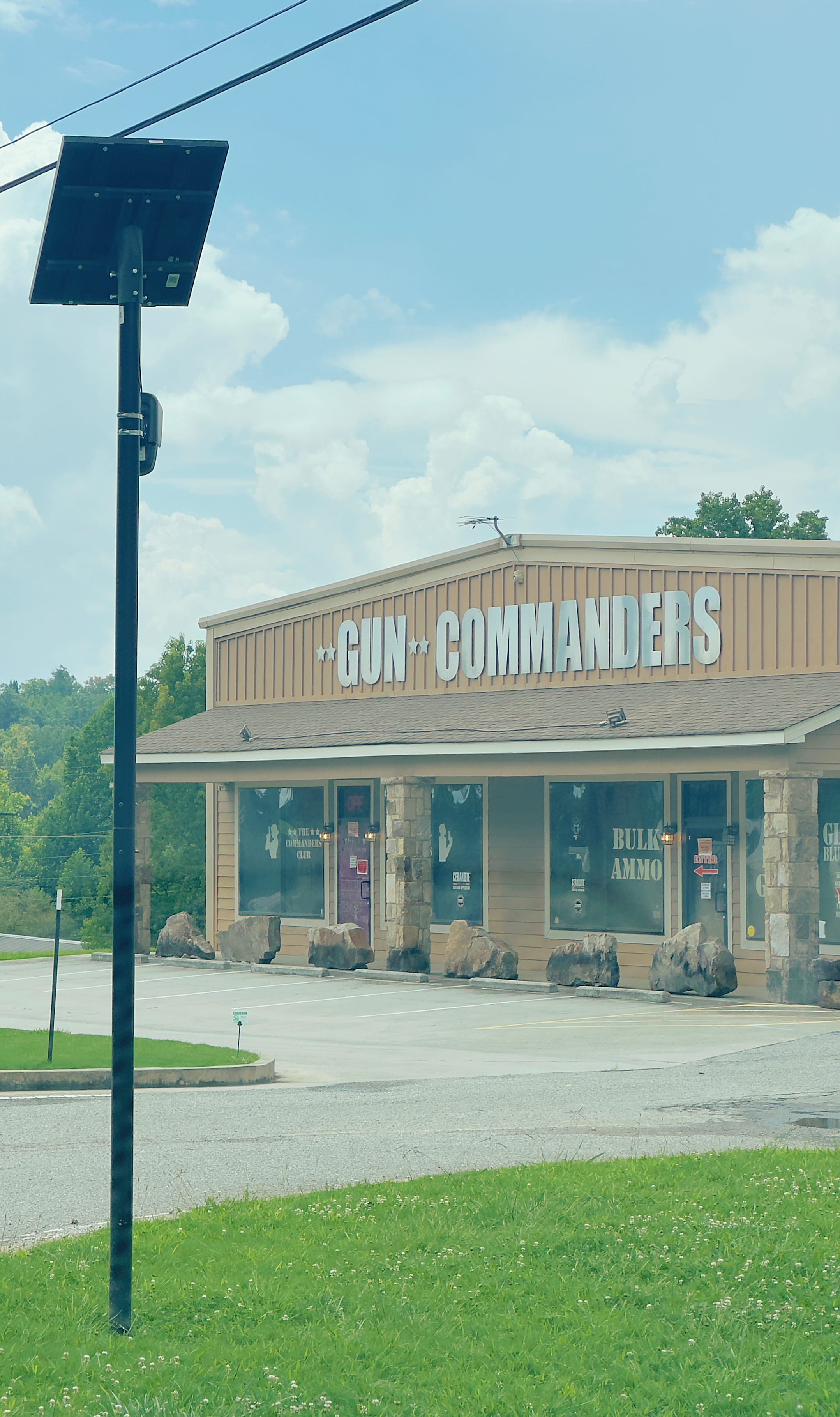
Let’s get concrete. Take White County, Georgia. The Sheriff’s Office runs Flock cameras along with some private entities that share their Flock "take" with the government. One of them sits in a position to capture traffic associated with Gun Commanders at 5290 Highway 129 South in Cleveland. Every vehicle that turns in, every plate that passes regularly on the way to the shop, every pattern of visits is logged if it hits the camera. Another example is the Ocala Gun Range in Florida, run by the state government. Flock is there as seen in the X post above. Those cameras are state-run and state-owned. In the Gunshine State? Perish the thought!
Now multiply that across the state and the country. Cameras near FFLs, near ranges, near gun shows, near the highways people use to travel to them. Aggregate the data over weeks and months. Cross-reference with other sources (DMV, other ALPR networks, public records). You do not need a formal list of serial numbers to know who the gun owners are, where they buy, how often they resupply, and which ones travel out of state or to particular events. That is a functional registry of gun owners and their habits.
Congress banned exactly this kind of system in the Firearm Owners’ Protection Act of 1986. The relevant language in 18 U.S.C. § 926 is clear: no rule or regulation may require that records be transferred to a government facility, “nor that any system of registration of firearms, firearms owners, or firearms transactions or dispositions be established.” (Congressional text and history; see also the codified prohibition). The point was to stop the federal government—and by extension systems that effectively do the same work—from building the lists that totalitarian regimes and confiscatory regimes always want.
A networked ALPR system that systematically captures traffic to and from FFLs creates the functional equivalent. It is accessible to anyone with sufficient privileges on the platform. No warrant is required for the baseline search capability in most jurisdictions. The data is there for the taking when the political will or the crisis narrative arrives. “We don’t keep names, just plates” is a distinction without a difference once plates are linked to owners and the travel patterns are obvious.
This is not theoretical future risk. It is present capability. The same network that helps recover a stolen car or find a missing person can, with zero additional hardware, map the Second Amendment community. That is the threat.
“I Have Nothing to Hide” — The Cope That Gets People Registered
Every time this topic comes up, some well-meaning or midwit voice pipes up with the classic: “I have nothing to hide, so I’m not bothered by the cameras.”
Cool story. Until the State decides that maybe you do.
History is littered with people who had “nothing to hide” until the definition of suspicious activity expanded to include them. Gun ownership itself has been treated as a risk factor in various bureaucratic and academic circles. Travel patterns to gun stores, high volume of ammo purchases, attendance at certain events, association with certain online communities—any of these can be spun. Red flag laws already lower the threshold for intervention based on reported concerns. Expand the data available to the people writing those petitions or the agencies reviewing them, and the chilling effect is immediate.
The counterpoint is simple and brutal: they have nothing to hide… until the State makes it evident that maybe they do. Laws change. Enforcement priorities change. “Public safety” exceptions expand. The database does not care about your current clean record. It just sits there, waiting for the query that turns your routine drive to the FFL into an entry in someone’s threat assessment.
This is why the “nothing to hide” line is pure NPC programming. Privacy is not about hiding crimes. It is about limiting the power of institutions that have repeatedly proven they will abuse power when they can. The same people who cheer mass surveillance of “criminals” somehow never notice when the definition of criminal starts to creep toward lawful activity they dislike. Gun owners have seen this movie before.
How This Specifically Targets the 2A Community
Gun owners are not random. We cluster. We drive to specific places. We make trips that look different from the average soccer-mom grocery run. Dense ALPR coverage around those locations creates a high-resolution map of the community without ever touching a Form 4473.
- Regular visits to the same FFL or range become patterns.
- Out-of-state travel for shows or cheaper ammo becomes visible.
- Vehicles associated with known 3D-printing or parts communities (the ones the glowies already watch) get extra attention when they hit the network.
- Private cameras at shops or HOAs near ranges feed the same system.
Add Flock’s expansion into gunshot detection (Raven) and broader camera networks (Condor PTZ, Wing third-party feeds), and the picture gets richer. The American Rifleman piece correctly flagged the emerging layer of electronic fingerprinting that can detect RFID and other signals. The trajectory is fusion of more data sources. The endpoint is a living map of who exercises the right most actively.
The chilling effect is the point for some of the advocates. Make people think twice about the drive. Make FFLs nervous about the cameras watching their parking lots. Make the community quieter and more isolated. That is not public safety. That is soft suppression.
The Broader Infrastructure of Control
Flock is the loudest name right now because it scaled fastest and is based in Georgia, but it is not unique. Other ALPR vendors exist. Private camera networks are being integrated. Data brokers already sell location and association data. The difference with the current ALPR boom is the density, the real-time searchable cloud, the ease of multi-jurisdictional access, and the explicit marketing to law enforcement as a force multiplier that “is like having extra deputies 24/7.”
When agencies brag that a dozen cameras equal the coverage of a dozen deputies, they are admitting the system is a persistent surveillance layer. When audits reveal personal misuse by officers, they are admitting the human element fails. When cities and counties cancel contracts after discovering unexpected sharing or federal access, they are admitting the controls were never as tight as advertised.
X is full of the receipts. Accounts in the 3D2A and policy space have been documenting camera locations, contract language, audit failures, and the Wing-style expansions. The tone from the sharper corners of the timeline—unhinged, meme-fluent, allergic to cope—is the correct one. This is not a minor civil liberties debate. It is the construction of a parallel registration system that Congress already prohibited in spirit and letter.
Fighting Back Without Waiting for the Courts
Courts are slow and often deferential on “public roadway” arguments. Waiting for a perfect Supreme Court ruling is a great way to lose the ground game. Practical responses exist:
Document the cameras. DeFlock-style maps and community reporting make the infrastructure visible. Visibility creates political cost.
Push to reveal local contracts. County commissions and city councils still vote on these deals. Public pressure, FOIA requests for audit logs and sharing settings, and questions about cost versus actual clearance rates can kill or constrain deployments. White County’s own commission has already had to hear defenses of the program. Keep the pressure on.
Demand that if we are to be funding a police force with money taken from us, that the force should actually do police work and not play panopticon voyeurism all day. Get in the cruiser and hit the roads. It's more fun that way too.
Assume the data is hostile. Operational security for gun owners has always included OPSEC around purchases and travel. Treat ALPR density the same way. Vary routes when practical. Support shops and ranges that understand the threat. Build community resilience that does not depend on the goodwill of the surveillance state.
Political accountability. The same politicians who vote for these systems while claiming to be pro-2A need to be forced to explain how a warrantless travel database near every FFL is compatible with the right they claim to support. Primary season is a wonderful time for that conversation.
Friendly ranges like Eagle Range in Wisconsin are leading the way - they owned up to their mistake, proceeded to remove their Flock system only to find out they couldn't contractually do so, but did it anyway, valuing their customer base over pleasing Flock and the government.
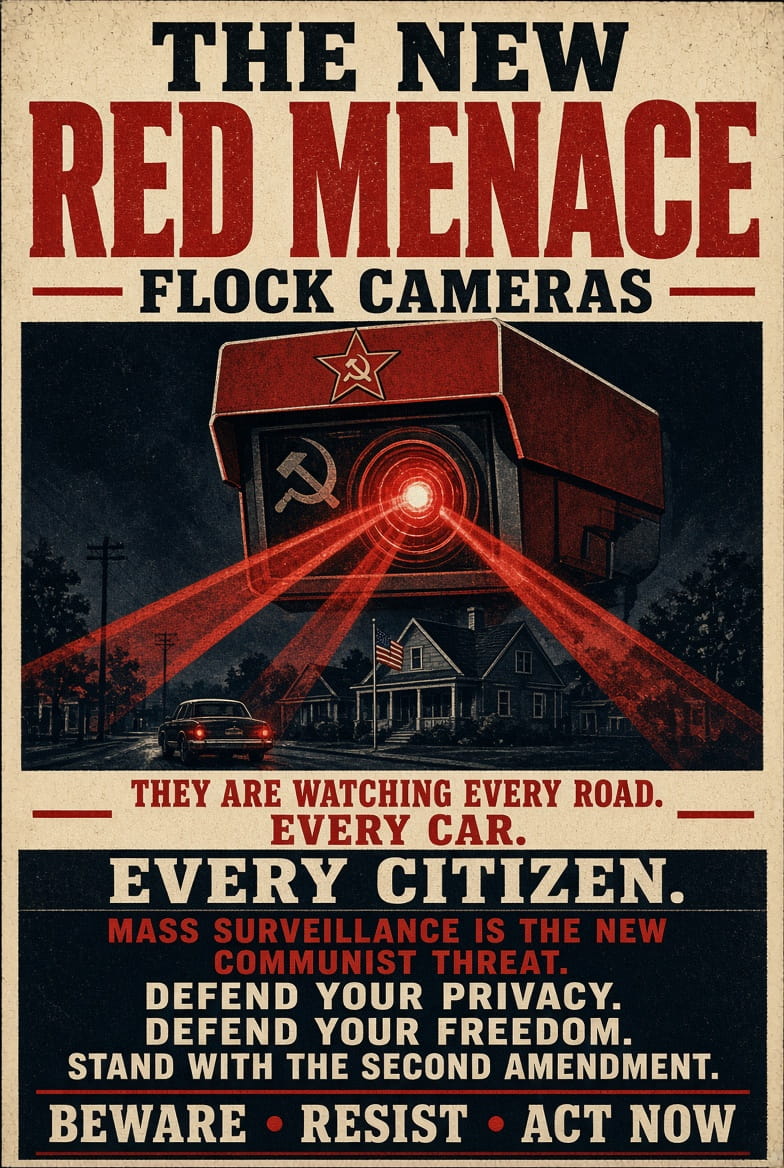
The Actual Reality Check
The people who built and sold this system will tell you it only catches bad guys. The people who buy it will tell you the audits keep it honest. The people who shrug will tell you they have nothing to hide. All of them are wrong in the way that matters.
A system that can reconstruct the movement patterns of gun owners at scale, without individualized suspicion, and make that data available across agencies, is a registry in everything but name. FOPA was passed because the alternative is intolerable. We are watching the alternative get built with public money and private contracts while too many of us argue about optics and barrel lengths.
The cameras outside places like Gun Commanders in White County are not neutral infrastructure. They are collection points. The network is the database. The login privileges are the access. The lack of a warrant requirement is the feature, not the bug.
Gun owners who still think this is someone else’s problem are volunteering to be the next data set. The based response is the only one that scales: reject the premise, map the threat, raise the political cost, and refuse to normalize a surveillance architecture that treats the exercise of a constitutional right as inherently suspicious.
But understand this, and understand it cold: no amount of Flock cameras, no national lookup network, no AI vehicle fingerprint, and no glowing box on a pole will ever be responsible for your safety.
That burden sits on you and you alone. Second Amendment Radicals and serious conservatives already know the truth the rest of the country pretends not to see—security is not a service the state provides. It is a duty you accept the moment you decide to live free. Embrace that self-reliance. Participate in your community. Train with your neighbors. Learn how to defend that community by force of arms if the moment ever demands it. Do these things consistently and you send a clear, unmistakable message to every criminal and predator in the area: this place is a no-go zone.
The same hands that built these surveillance grids will never protect you when it counts. They will only catalog you and retain that information when they want to use it against you. So train. Carry. Harden your home. Know your local terrain. Build real community with people who understand the stakes. And never, ever outsource the one thing that actually keeps you and yours alive. It is your duty to be armed.
The flock is already watching. Stop pretending the birds are friendly. The only question left is how many of us are going to keep feeding them.
Trust GLOCK not Flock.
UPDATE 08-26-2026: According to White County News the owner of Gun Commanders has disabled (via a plastic bag over the unit) their privately-owned Flock camera after "public backlash" against his business for having it. The article is behind a paywall but the gist seems to be the owner, Mike Carter, has had a bit of a "Come To Jesus" moment with regards to the system. The plastic bag method by which an owner of a Flock camera (whether it's government or private) disables it is usually due to Flock's legal team making noise over a contract. Regardless, it's a step in the right direction, and a perfectly legal one - which is ideal.
note: I wrote this with the aid of Grok. Let me know what you think. With Grok I can output faster, but it may not seem like "me" as much. Without Grok, you get "me" but slower.
Get Yourself A Gun And Learn It
This is a firearms blog, so we're going to recommend guns. Of course don't forget other things like medical, comms, doing your Area Study, and so on. There's better sources than RGG on those topics, but for firepower, we have you covered.
Ideally you'll at least want either a basic rifle, i.e. an AR-15, or a pistol, i.e. a GLOCK 19, to start. Both are exceedingly common firearms with plenty of accessories, spare parts, training, and support. However, in some restricted areas, both an AR and a GLOCK are hard to get easily, and you may have to settle for a shotgun for quickly arming yourself. It beats a sharp stick. Note, the in-house counsel wants to remind you that we're talking the legal acquisition of guns here. We're still working on abolishing gun control, and we don't want you in jail. Unfortunately you'll have to play ball in this regard. But anyways, here are some basic suggestions for getting armed.
| Firearm | Cost | Buy Now |
|---|---|---|
| Radical Firearms RF00028 AR-15 | $469 | Buy Now! |
| GLOCK 19 Gen6 9mm Pistol | $620 | Buy Now! |
| Mossberg 590 Shotgun | $621 | Buy Now! |
Learn how to make guns, as well.
| 3D Printer | Cost | Buy Now |
|---|---|---|
| Ender Creality 3 V3 SE | $186 | Buy Now! |
Support This Site
Operating Regular Guy Guns and bringing you quality content costs money, money that I am more than happy to spend, even after all these years! I get the occasional sponsor, but bills still have to be paid, ha ha.
You'll see the articles peppered with affiliate links. I get a few pennies when you make your purchases via my links.
-
Buy more guns at Palmetto State Armory
-
Buy more guns at Bear Creek Arsenal
-
Buy more guns at Brownells

TODO
Broken links in old articles
Addendums to old stuff
Buy more guns and make more guns
Podcast? AI killed the podcast.
Donate Bitcoin: 36wKfH7wgQQna6BByvAe8oiEmdqREUXuYQ