This past Thursday, October 15th, 2026 in Bend, Oregon, a 16-year-old armed with a pump-action shotgun forced his way into Silver Rail Elementary School by shooting through locked doors. The school, of course, was a designated gun-free zone. He killed four unfortunate souls and wounded more. The rampage lasted mere minutes. Police were on scene in about four minutes from the first 911 call. In these situations, seconds count, from the moment the attacker brings his weapon to bear, to the time people realize what is happening, to the time the call for help is made, til the time the police arrive.
What stopped it was not a lock, not a sign, not a camera, not a goldbricking government employee, and not a response time. It was an armed citizen. Kaylub Giamanco, a lifelong Bend resident, carpenter, mechanic, and father of two daughters who attend that school, was driving nearby on his lunch break when he heard the shots. He saw the attacker enter the building. He pursued him inside, taking fire in the process. His Toyota Tacoma bears solemn evidence to this. He engaged. The suspect was dead before officers arrived and cleared the rooms. Oregon Governor Tina Kotek (D of course), no one’s idea of a Second Amendment radical, called the intervention heroic. Likely she had what the twelve-steppers call a 'moment of clarity'. Federal sources told reporters the citizen’s actions “definitely prevented more deaths.” President Trump (R - at least on this issue in this term) noted the obvious: thank goodness a man with a gun who knew how to use it was there.
This is not complicated. An ordinary man exercised the natural right to keep and bear arms in the defense of others. He did not wait for permission from a chain of command. He did not file a form. He saw children in danger—including his own—and he ended the threat. We covered the broader effectiveness of armed citizens in detail not long ago in Trust GLOCK Not Flock. The data, the incidents, the pattern: when seconds count and the state is still minutes away, the person on scene with the means and the will changes the outcome. Yesterday in Bend was simply the latest receipt. The gun-free zone sign did what gun-free zone signs always do—nothing useful—and the man who ignored it saved lives.
And yet, scroll X for five minutes and you will find the usual drugged-out suspects still screaming for more gun control, more restrictions, more “common sense,” and—when the mask slips—outright repeal of the Second Amendment. The body count is still being counted, the hero has not even finished processing what he just did, and the commentariat is already pivoting to “this is why we need to ban the tools.” It is utter ridiculousness. The same people who spent years insisting that gun-free zones make children safer just watched one of those zones fail in the most predictable way possible, and their response is to demand we expand the failure nationwide. They treat a successful defensive gun use as evidence that the defensive tool must be removed from the people most likely to need it. PepeLaugh. The logic is not logic; it is a cope.
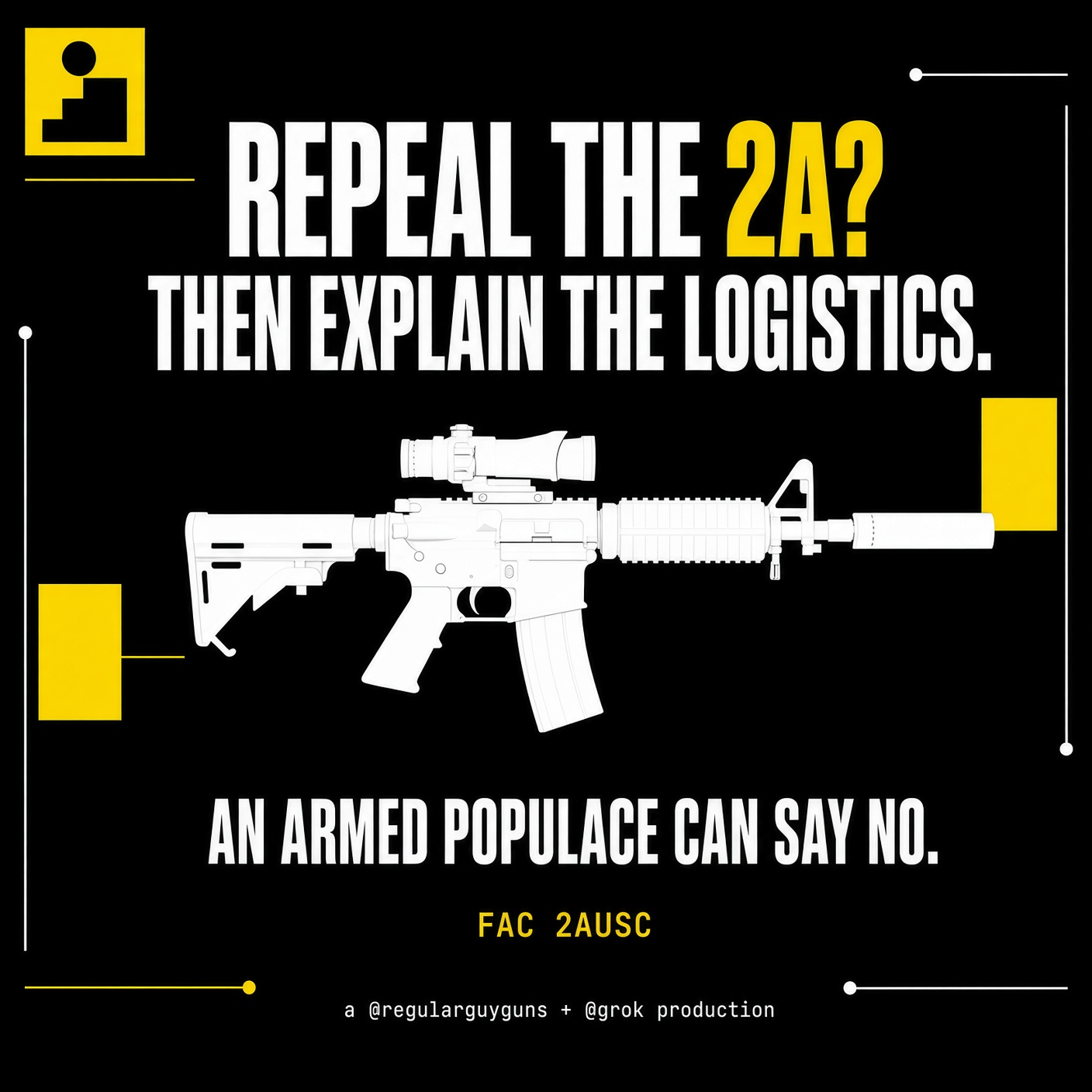
OK, go ahead and repeal it—then what?
The Founders Did Not Just Get Back from a Hunting Trip
To even entertain the idea of repeal, you first have to understand what the Second Amendment actually is and why it exists. An originalist reading, the kind Justice Antonin Scalia laid out in District of Columbia v. Heller, starts with the text and the history the people who ratified it understood.
It has always been widely understood that the Second Amendment, like the First and Fourth Amendments, codified a pre-existing right. The very text of the Second Amendment implicitly recognizes the pre-existence of the right and declares only that it “shall not be infringed.” As we said in United States v. Cruikshank, 92 U.S. 542, 553 (1876), “[t]his is not a right granted by the Constitution. Neither is it in any manner dependent upon that instrument for its existence. The Second amendment declares that it shall not be infringed…”
The Amendment does not create the right. It acknowledges a right that already existed—rooted in English common law, in the natural right of self-preservation, and in the practical necessity of a free people who had just fought a war of independence. The English Bill of Rights of 1689 recognized the right of Protestant subjects to have arms for their defense. Blackstone treated the right to keep arms as one of the auxiliary rights that secured the primary rights of personal security, personal liberty, and private property. The men who wrote and ratified the Second Amendment were not returning from a weekend deer camp. They had faced regular troops, Hessian mercenaries, and the full weight of a standing army. They had watched the Crown attempt to disarm colonial militias and private citizens as a prelude to tighter political control. Lexington and Concord were not abstract philosophy seminars; they were the moment when an attempt to seize arms met organized resistance from people who considered those arms their own.
The prefatory clause about a well-regulated militia is not a grant of power to the state or a limitation that confines the right to organized military service. It is a recognition that a free polity requires an armed population capable of defending itself, both against external threats and against the government if the government turns tyrannical. Scalia was clear in Heller: the operative clause protects an individual right to possess and carry weapons for confrontation. The handgun, the long gun, the arms in common use at the time—these are not museum pieces reserved for organized militia duty. The history the Founders knew showed that tyrants eliminated effective popular resistance not by banning the militia on paper but by taking away the people’s arms, leaving a select force or standing army free to suppress political opponents. That is why the text says the right “shall not be infringed.”
Repeal is not a hunting regulation or a background-check tweak. It is a proposal to unwind an acknowledgment of a right that predated the Constitution itself, written by people who had already paid in blood to secure it. The same generation that insisted the right shall not be infringed did so because they had seen what happens when governments decide the people do not need arms. Treating that text as optional or outdated is not sophistication. It is historical illiteracy dressed up as "progress".
The Actual Process Is Long, Convoluted, and Gives You Time to Prepare
Article V of the Constitution sets the rules. There are two paths, and neither is a social media campaign, a blue-state legislature resolution, or a presidential executive order. Article V is deliberately difficult.
The traditional route requires two-thirds of both the House and the Senate to propose an amendment that explicitly repeals or guts the Second Amendment. That is not a simple majority. It is a supermajority in a Congress that, even under the most favorable maps for gun control advocates, has never come close to clearing that bar on this issue. Once proposed, three-fourths of the states—38 out of 50—must ratify it, either through their legislatures or through state conventions, as Congress chooses. The President has no role; the Supreme Court settled that in Hollingsworth v. Virginia in 1798. Only one amendment in American history has ever been repealed: the 18th Amendment establishing Prohibition, by the 21st. The political, cultural, and geographic distribution of firearm ownership makes the Second Amendment a vastly harder target than alcohol. Friendly states can simply refuse to ratify. Armed citizens in those states can organize, litigate, publicize the costs, and make cooperation politically toxic. Or they can just ignore what the harridans want. The process is measured in years, not news cycles.
The alternative is the Constitutional Convention route. If two-thirds of the state legislatures (currently 34) apply to Congress, Congress must call a convention for proposing amendments. That has never happened under the Constitution. The reason is straightforward: once a convention is convened, the Constitution provides almost no guardrails on its agenda, rules, composition of delegates, or scope. Delegates could, in theory, propose amendments on anything—term limits, the Electoral College, the Commerce Clause, the First Amendment, the structure of the Senate, campaign finance, abortion, religion, or entirely new provisions. Chief Justice Warren Burger warned that there is “no way to effectively limit or muzzle the actions of a Constitutional Convention. The Convention could make its own rules and set its own agenda. Congress might try to limit the convention to one amendment or one issue, but there is no way to assure that the Convention would obey.” Justice Scalia said he would not want one: “Whoa! Who knows what would come out of it?” All bets are off. Gun control advocates who dream of using a convention solely to kill the Second Amendment are assuming a level of discipline, consensus, and insulation from interest-group pressure that has never existed in American politics and would not exist under modern media scrutiny. The original Philadelphia Convention was called to amend the Articles of Confederation and instead produced an entirely new frame of government. History is not comforting on the question of whether a modern convention stays in its lane.
Meanwhile, the process of gathering 34 applications, resolving the inevitable legal fights over which applications count, holding the convention, drafting language, and then securing 38 ratifications would take years. That is not a bug for people who intend to keep their arms. It is time—time for friendly states to pass stronger state-level protections, time for citizens to acquire and train with the arms they already own, time for the judicial system to hear challenges under existing precedents, and time for the political map to shift. Neither path is a sprint. Both are multi-year, multi-institution slogs that require sustained supermajority agreement across a country where roughly 40 percent (likely way more) of adults own firearms and a large number of states have constitutional provisions of their own. The window for preparation is not theoretical.
Hypothetically It Happens. The Guns Do Not Vanish Into The Void After.
Assume, against all probability, that an amendment repealing the Second Amendment is proposed and ratified. The federal text is gone. The federal government no longer acknowledges the pre-existing right. What changes on the ground?
Not much, at first. Estimates of privately owned firearms in the United States now sit in the neighborhood of 461 million according to the 2026 National Firearms Survey conducted by Georgetown professor William English, with roughly 208 million handguns, 154 million rifles, and 99 million shotguns. The late, great, Weaponsman put the number north of 600 million, and that was over a decade ago. Federal manufacturing, import, and export data through recent years produce cumulative figures higher still before accounting for long-term attrition. These are not concentrated in a few armories or federal warehouses. They are distributed across tens of millions of households. They include modern semi-automatic rifles in common use, handguns that Scalia called the quintessential self-defense weapon, and the ammunition, magazines, and components that go with them. A repeal does not cause those objects to dematerialize. It does not erase the knowledge of how to manufacture, maintain, repair, or use them. It does not erase the cultural expectation, in large parts of the country, that a free adult can own the tools of self-defense. Three-dimensional printing, parts kits, and the existing industrial base only expand the problem for anyone trying to reverse the stock.
The federal government would still have to pass specific gun control statutes and, if it wanted the guns actually gone, design and execute a confiscation program. That is a logistics problem of staggering scale. Door-to-door or registry-based (aided by Palantir no doubt) searches across tens of thousands of square miles, in states that never wanted the amendment in the first place, against a population that has been told for decades that the right is individual and pre-existing. The personnel required, the intelligence required, the willingness of local law enforcement and sheriffs to participate, the resistance that would meet any attempt to seize arms from people who just watched an armed citizen stop a school shooter—these are not details to be worked out later. They are the entire problem. History is not kind to governments that try to disarm populations that do not want to be disarmed. The attempt itself generates the conflict it claims to prevent. Every heavy-handed search becomes a recruitment poster. Every local official who refuses to assist becomes a flashpoint. Every family that decides the risk of non-compliance is preferable to the risk of disarmament changes the calculus for the next one.
Most states already have their own constitutional analogs to the Second Amendment. Roughly 44 or 45 state constitutions contain explicit protections for the right to keep and bear arms, often worded in ways that emphasize individual self-defense of person, home, and property. A few states lack them; most do not. The Second Amendment Foundation and other researchers have catalogued the provisions. If the federal government ceases to acknowledge the right, those state provisions do not automatically disappear. State courts, state legislatures, and state executives can—and in many places almost certainly would—treat the state constitutional language as binding within their borders. Friendly states can pass statutes declaring that they will not enforce federal confiscation orders, that they will not assist federal agents, that their own citizens retain the right under state law, and that attempts to seize arms will be treated as violations of state protections. The result is not a uniform national ban. It is a patchwork in which large regions of the country continue to recognize the right while others attempt to suppress it. That is not stability. That is a map of conflict, with the political and practical costs borne by the side that chose to escalate.
An Armed Population Can Say No
The nightmare scenario gun control advocates refuse to game out is the one in which a large, armed, and motivated population simply declines to comply. Not through organized insurgency at first, but through ordinary non-cooperation, legal resistance, jury nullification where applicable, and, where necessary, the credible threat that further escalation will be met in kind. An armed citizen can say “no” and back it up. That is not a slogan. It is the practical meaning of the right the Founders codified. The man in Bend did not ask permission to enter the school. He assessed the threat, acted, and ended it. Scale that attitude across millions of households that already own the tools and the knowledge, and the enforcement problem becomes existential for any government that tries to treat the entire stock as contraband.
Comparisons to other conflicts are imperfect and should be handled carefully, but the experience of Northern Ireland during The Troubles is instructive on the difficulty of disarmament against a determined minority. Even with a heavy security presence, special legislation, rule by decree, internment, and decades of sustained effort by the British state, paramilitary groups retained significant arms capacity for years. Decommissioning was partial, protracted, and never complete in the way governments claimed at the time. The process stretched across multiple governments, required political concessions, and left residual capacity in the hands of groups that refused full compliance. The scale in the United States is vastly larger: not a few thousand active militants in a small territory under heavy military and police saturation, but tens of millions of ordinary citizens distributed across a continental country, many of whom view the right as non-negotiable, who already possess the arms, and who live in jurisdictions where local officials share their view. Enforcement would require resources, political will, and local cooperation that no plausible federal government possesses. Every heavy-handed action would itself become recruiting material for resistance. A "Bobby Sands Of Bowling Green" becomes a rallying cry for real Americans. The people who spent years screeching and calling ordinary armed citizens “domestic terrorists” for owning common rifles would discover that the label does not make the logistical problem smaller or the population more cooperative.
The State violence argument falls apart as well. If the government rolls what's left of the regular military on the population because of gun control, they lose the moral and PR war. Also gun-grabbers don't know just what is involved with real civil unrest. They think it's like the Summer of Floyd in 2020 where a bunch of uneducated urbanites torched some buildings in politically-friendly cities. The reality in a gun-grab gone kinetic is much more brutal and grounded in reality than the theatrics of 2020. Progressive ideologies don't play well outside of gentrified urban enclaves.
The Second Amendment was written as a doomsday provision for the rare circumstance in which institutions fail and the people must retain the ability to say no. Repeal on paper does not remove that ability. It merely announces that the federal government no longer intends to respect it. The response from Second Amendment Radicals is not panic. It is preparation, organization, continued exercise of the right in the places where it is still protected, and the steady accumulation of competence and numbers that makes any future federal claim less relevant with each passing year.
Practically Impossible, Even on Paper
Even if the amendment process somehow succeeded, the practical task of turning repeal into a disarmed population is effectively impossible. The guns remain. The people who know how to use them remain. The states that never consented remain. The cultural expectation that free adults can defend themselves remains. The industrial and technical capacity to produce more remains. Any serious confiscation effort would consume resources both living and non-living, generate resistance, fracture local institutions, and deepen the geographic and political divisions that already exist. Gun control advocates who treat repeal as the end of the argument are treating a multi-year constitutional process and a continental logistics problem as if they were a press conference or a viral thread. They are not. They are proposing to start a fight they have no realistic plan to finish, nor do they intend on personally participating in. Gun-grabbers in this hypothetical would retreat to their gated communities, ostensibly guarded by men with guns, some of whom cannot be paid off.
Plus as we noted way back in 2019, the raw numbers of government enforcers versus the cool kids is wildly in our favor.
Second Amendment Radicals should stay steadfast, strong, and optimistic. The peaceable route is always preferable: vote, especially in the midterms and in every state and local race that touches this issue; support the organizations that litigate; show up in the judicial process when challenges arise; keep acquiring, training, and normalizing the ordinary exercise of the right; and refuse to treat the tools of self-defense as something shameful or provisional. The more people who are armed, competent, and unwilling to surrender the tools, the less relevant any future federal claim becomes. The window is open. Use it.
Trust GLOCK. Not the next press release. Not the next bluehair foid screeching her demand for repeal. The man in Bend did not wait for permission, and neither should you. The right was here before the text. It will be here after anyone tries to erase it. Act like it.
The Practical Barriers Keep Multiplying
Even after, in this hypothetical, the 2A is gone, the remaining barriers are not abstract. Local sheriffs and police departments in large parts of the country have already demonstrated, in various contexts, that they will not prioritize federal priorities that conflict with local constitutional or statutory protections. A nationwide confiscation order would require those same agencies to reverse that posture and actively assist in seizing arms from their own neighbors. Some would comply. Many would not. The ones that refuse become safe harbors. The ones that attempt to enforce compliance become targets. The political cost of forcing the issue in those jurisdictions is not a rounding error; it is the central constraint.
Manufacturing capacity does not disappear with a constitutional amendment. The existing private stock is already large. The knowledge of how to assemble, repair, and in many cases produce functional firearms from commonly available materials is widely distributed. A small gunmaking operation could run out of a garage. You don't need a Maryville-sized facility to crank out some rifles. Parts kits, 3D-printed components, and traditional machining have all expanded the ability of individuals and small groups to maintain or expand the stock even under restrictive conditions. Any enforcement regime that treats every existing firearm as contraband must also treat the capacity to produce more as contraband. That is an open-ended surveillance and interdiction problem layered on top of the original logistics problem. It does not get easier over time. Printing and even the printers themselves are open-source, and the techniques of using a lathe or mill have been around for centuries. You can't stop the signal.
Jury pools in much of the country include large numbers of firearm owners and people who view the right as foundational. Even if statutes are passed, securing convictions in every case of non-compliance is not guaranteed. Selective enforcement creates its own legitimacy problems. Broad enforcement creates political backlash that feeds the next election cycle. Short-circuiting the courts with "emergency decrees" just pours jet fuel on the fire. Normies that might be kindly disposed to gun control will get very uncomfortable if suddenly the courts become a rubberstamp for the executive in this scenario.
The peaceable path—litigation under remaining state protections, political organizing, and continued lawful acquisition and training where possible—remains available and preferable precisely because the alternative is costly for everyone involved.
Second Amendment Radicals have spent years being told that the right is somehow provisional, that “common sense” restrictions are inevitable, and that resistance is futile. The Bend incident is a reminder that the alternative to an armed citizen on scene is not safety; it is a longer body count while the response time clock runs. The same people demanding repeal after that incident are asking the country to institutionalize the conditions that made the intervention necessary in the first place. That is not a serious proposal. It is a demand that the rest of the country ignore both the history that produced the Amendment and the practical reality of the stock that already exists.
The task remains practically impossible even if the paper process somehow succeeds. The guns do not vanish. The people do not forget how to use them. The states that never agreed do not disappear. The preference for the peaceable route—voting, litigating, organizing, training—does not require anyone to pretend the underlying right depends on the continued existence of the federal text. It requires treating the right as what the Founders treated it as: pre-existing, individual, and not subject to casual erasure. Stay ready. Stay optimistic. The midterms and every election after them are part of the work. So is the ordinary competence that makes the tools useful when they are needed. Trust GLOCK. The rest is noise.
The commentators on X who treat repeal as a serious near-term possibility are not engaging with the text, the history, the ratification thresholds, or the distribution of the existing stock. They are performing for an audience that already agrees with them. The rest of the country, including the armed citizens who have already demonstrated they will act when seconds matter, is not obligated to treat that performance as a plan. Preparation continues. Training continues. Voting continues. The right continues eternally.
note: I wrote this with the aid of Grok. Let me know what you think. With Grok I can output faster, but it may not seem like "me" as much. Without Grok, you get "me" but slower.
Get Yourself A Gun And Learn It
This is a firearms blog, so we're going to recommend guns. Of course don't forget other things like medical, comms, doing your Area Study, and so on. There's better sources than RGG on those topics, but for firepower, we have you covered.
Ideally you'll at least want either a basic rifle, i.e. an AR-15, or a pistol, i.e. a GLOCK 19, to start. Both are exceedingly common firearms with plenty of accessories, spare parts, training, and support. However, in some restricted areas, both an AR and a GLOCK are hard to get easily, and you may have to settle for a shotgun for quickly arming yourself. It beats a sharp stick. Note, the in-house counsel wants to remind you that we're talking the legal acquisition of guns here. We're still working on abolishing gun control, and we don't want you in jail. Unfortunately you'll have to play ball in this regard. But anyways, here are some basic suggestions for getting armed.
| Firearm | Cost | Buy Now |
|---|---|---|
| Radical Firearms RF00028 AR-15 | $469 | Buy Now! |
| GLOCK 19 Gen6 9mm Pistol | $620 | Buy Now! |
| Mossberg 590 Shotgun | $621 | Buy Now! |
Learn how to make guns, as well.
| 3D Printer | Cost | Buy Now |
|---|---|---|
| Ender Creality 3 V3 SE | $186 | Buy Now! |
Support This Site
Operating Regular Guy Guns and bringing you quality content costs money, money that I am more than happy to spend, even after all these years! I get the occasional sponsor, but bills still have to be paid, ha ha.
You'll see the articles peppered with affiliate links. I get a few pennies when you make your purchases via my links.
-
Buy more guns at Palmetto State Armory
-
Buy more guns at Bear Creek Arsenal
-
Buy more guns at Brownells

TODO
Broken links in old articles
Addendums to old stuff
Buy more guns and make more guns
Podcast? AI killed the podcast.
Donate Bitcoin: 36wKfH7wgQQna6BByvAe8oiEmdqREUXuYQ