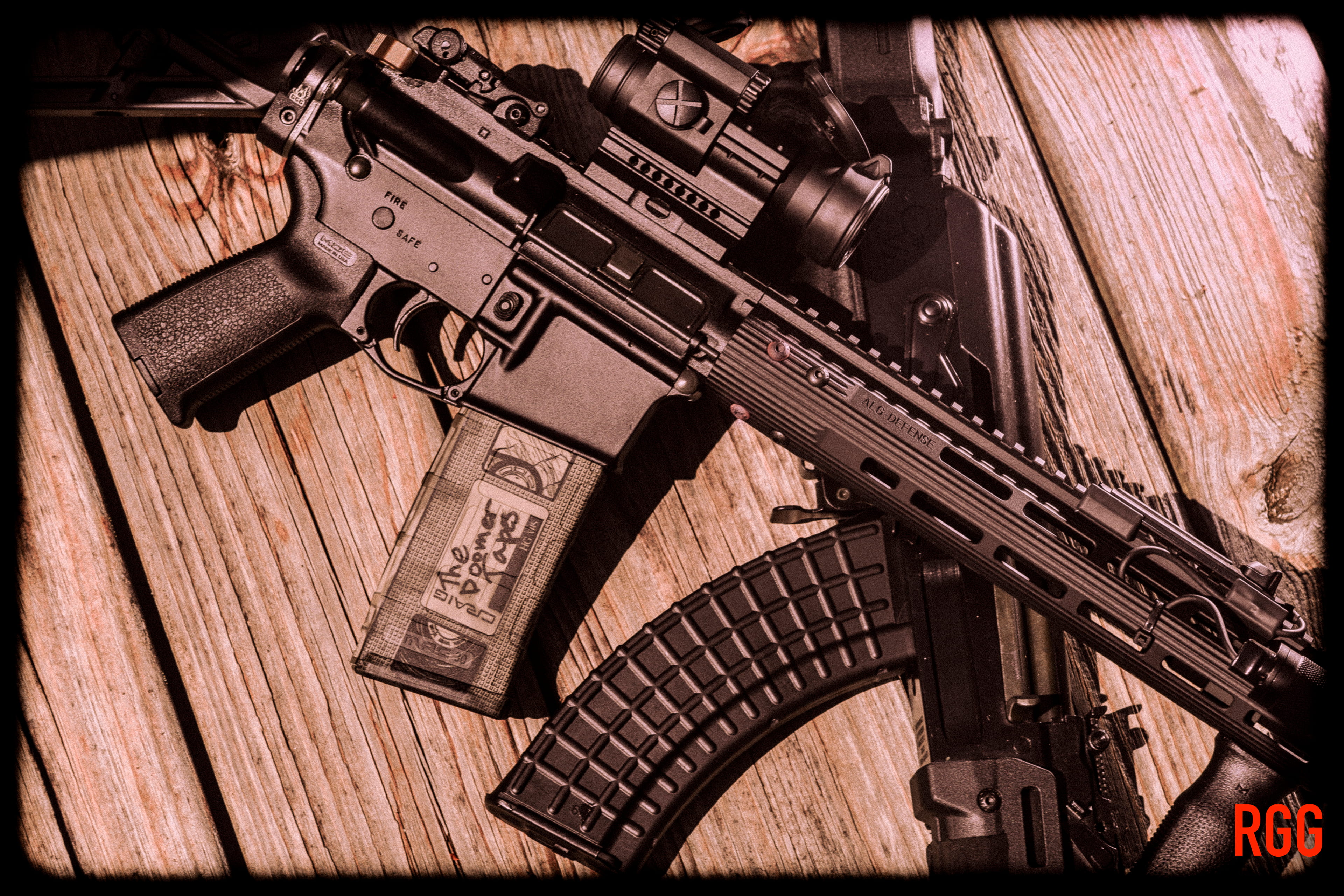
SCOTUS Is Coming for “Assault Weapons” Bans — And the Third Circuit Just Lit the Fuse
Hold onto your plate carriers and grab a cold C4 - The last three weeks have been the most exciting stretch for the Second Amendment in years, and the fireworks are only getting started.
On June 30, 2026, the Supreme Court granted certiorari in two cases that finally put the question of “assault weapons” bans squarely in front of the justices: Viramontes v. Cook County out of Illinois and Grant v. Higgins out of Connecticut. Those cases challenge the kind of feature-based and name-based semi-automatic rifle bans that gun-control advocates have treated as settled policy for more than a decade. The Court consolidated them for one hour of argument in the October Term 2026. That alone was big.
Then, on July 17, the Third Circuit Court of Appeals dropped a legal thermonuclear device on New Jersey’s nearly identical ban in ANJRPC v. Attorney General of New Jersey (the long-running challenge also known as the Cheeseman case). In a clean application of Bruen, the court held that New Jersey’s prohibition on AR-15-style semi-automatic rifles and magazines holding more than ten rounds violates the Second Amendment. It is the first federal appeals court to actually strike down a state “assault weapons” ban under the post-Bruen framework. The circuit split that advocates have been begging for just materialized in living color.
The combination of these two developments has changed the entire temperature of the fight. What used to be a series of defensive battles in hostile circuits has suddenly become an offensive campaign with real momentum. Those who simply want to own the most popular semi-automatic rifle in American history finally have reasons to smile that go beyond the cope of "holding the line".
Additional info courtesy of Second Amendment Foundation’s announcement and News2A coverage.
The Third Circuit Bombshell
New Jersey had one of the strictest and oldest “assault weapons” regimes in the country. In 1990, they banned a long list of specific models by name and any semi-automatic rifle that came equipped with features the legislature found scary: a pistol grip that protrudes conspicuously beneath the action, a folding or telescoping stock, a flash suppressor, a threaded barrel, or a magazine that accepted more than ten rounds. The law criminalized possession, sale, and transfer. It was the full package of overweening oppression.
For years, lower courts had bent themselves into pretzels to uphold these laws after Bruen. They invented “militaristic character” tests, narrowed the common-use inquiry until it was almost meaningless, or simply declared that the state’s interest in public safety was so weighty that history and tradition could take a back seat. The Third Circuit refused to play that game.
Applying the text, history, and tradition framework from Bruen, the court looked at the undeniable reality that AR-15 platform rifles are among the most commonly owned firearms in the United States and concluded that New Jersey’s ban could not stand. The magazine restriction fell with it. Our side correctly called it a historic victory. New Jersey’s Attorney General and Governor, as expected, declared the sky was falling and took to opposition social media channels to cry about it, and still get ratioed. Even richer was that the decision was written by Biden-era appointee, Judge Arianna Freeman, who appears to be in the redemption arc of her story.
This ruling matters for reasons that go far beyond the Garden State. Until July 17, every federal circuit that had ruled on the issue post-Bruen had upheld the bans. The absence of a circuit split was one of the excuses the Supreme Court had used (or at least allowed) to deny earlier petitions. That excuse is now gone. The Third Circuit has created the split, and it did so with a full-throated endorsement of the common-use doctrine that Heller and Bruen actually require.
The SCOTUS Cases Just Got Supercharged
Viramontes v. Cook County challenges the Cook County ordinance that served as the prototype for Illinois’ later statewide ban. Grant v. Higgins challenges Connecticut’s ban, which lists specific models by name and also prohibits any semi-automatic centerfire rifle that meets certain feature tests or has an overall length under thirty inches. Both laws treat the AR-15 platform and its close relatives as presumptively illegal for ordinary citizens.
The Supreme Court granted cert on the core question: whether the Second and Fourteenth Amendments guarantee the right to possess AR-15 platform and similar semi-automatic rifles. The cases were already significant. With the Third Circuit’s ruling now on the books, they have become something closer to inevitable.
The Court will not be deciding these questions in a vacuum. It will be deciding them against the backdrop of an actual appellate decision that did the hard work of applying Bruen honestly and reached the conclusion that these bans are unconstitutional. That changes the dynamic of briefing, the tone of oral argument, and the political cost of any attempt to uphold the bans through judicial creativity.
Justice Kavanaugh had already telegraphed the direction of travel in earlier statements respecting the denial of certiorari. He noted that Americans possess an estimated 20 to 30 million AR-15s (truth is that number is probably double!), that these rifles are legal in the overwhelming majority of states, and that there is a strong argument they are in common use and therefore protected under Heller. The Third Circuit just gave that argument real-world force.
What Even Is an “Assault Weapon,” Anyway?
Before we go further, it is worth pausing on the linguistic scam at the heart of this entire debate.
The term “assault weapon” did not emerge from careful engineering analysis or military doctrine. It began life in the early 1980s as a firearms-industry marketing term. Manufacturers used “assault” language to sell civilian semi-automatic rifles that borrowed styling cues from military designs. It was advertising copy, pure and simple.
Then the activists got hold of it. Josh Sugarmann of the Violence Policy Center is the most famous example. In a 1988 paper, he explicitly recommended that gun-control groups exploit the “menacing looks” of these rifles and the public’s confusion between semi-automatic and fully automatic firearms. The goal was not precision. The goal was to create a new category of firearms that could be banned by appearance rather than by function.
And that is exactly what the laws do. The features that trigger the bans — pistol grips, adjustable stocks, flash hiders, barrel shrouds, threaded barrels — do not change the rate of fire, the cartridge, or the fundamental operating system. A semi-automatic rifle with a pistol grip fires one round per trigger pull, just like a semi-automatic rifle without one. The features affect ergonomics and aesthetics. They do not turn a civilian sporting rifle into a machine gun.
Yet for more than three decades, legislators have treated these cosmetic and ergonomic differences as if they were the difference between a hunting rifle and a weapon of war. The Third Circuit just refused to continue the charade. The Supreme Court now has the chance to end it for good.
The Numbers Don’t Lie
National Shooting Sports Foundation data puts the total number of Modern Sporting Rifles — the industry term for AR- and AK-style semi-automatic centerfire rifles — in civilian hands at roughly 32 million. Justice Kavanaugh’s own figures put pure AR-15 numbers in the 20–30 million range. These are not rare collectibles. They are the most popular centerfire semi-automatic rifles sold in the United States for decades.
They are used for home defense, competitive shooting, formal and informal training, pest control, and hunting in appropriate calibers and configurations. They are modular, accurate, low-recoiling in the common .223/5.56 chambering, and easy to shoot well. That is why so many Americans chose them. The idea that a category of firearm owned by tens of millions of law-abiding citizens can simply be banned because some legislators find the aesthetics threatening has always been constitutionally suspect. It is now judicially collapsing.
The Broader Map of the Fight
New Jersey was not alone. California, New York, Maryland, Massachusetts, Connecticut, Illinois, Hawaii, and a handful of other states still maintain aggressive “assault weapons” bans. Several of those laws are currently in various stages of litigation. The Third Circuit’s decision and the Supreme Court’s decision to take the Illinois and Connecticut cases put every one of those statutes under a much brighter spotlight.
Some of the bans are more extreme than others. Some include registration requirements, some do not. Some have limited grandfathering, some effectively force owners to surrender or permanently disable their rifles. All of them rest on the same constitutional theory that just took a direct hit in the Third Circuit: that the government can ban an entire class of commonly owned semi-automatic rifles based on features that do not change their function.
If the Supreme Court follows the logic of Heller, Bruen, and the Third Circuit, those laws are in serious trouble. Even a narrower ruling that strikes down the most aggressive feature tests while leaving name-based lists intact would still represent a massive shift from the status quo of the last fifteen years.
The Coming Pivot: Bureaucracy as the New Ban
Even if the pure hardware bans start falling, no serious observer expects the most determined gun-control jurisdictions to simply give up. The next playbook is already visible.
Colorado’s Senate Bill 25-003, which takes effect August 1, 2026, offers a clear preview. Under that law, Coloradans who want to purchase many semi-automatic rifles that accept detachable magazines — including AR-15 platforms — must first obtain a special eligibility card from their county sheriff. The process requires a background check, government ID, a fee, and the sheriff’s approval or denial. On top of that comes mandatory in-person safety training with a certified instructor.
It is not a flat ban. It is something more insidious: a discretionary, multi-step, locally administered permitting regime that inserts law enforcement as the gatekeeper for the acquisition of common modern rifles. Existing owners are generally grandfathered. Law enforcement and military get carve-outs. Everyone else gets the bureaucratic obstacle course.
This is the model that blue states are likely to expand if the Supreme Court makes pure possession bans harder to defend. It mirrors the European approach in which semi-automatic rifles are theoretically legal but subject to lengthy applications, character references, police interviews, home storage inspections, “need” demonstrations, medical evaluations, high fees, and periodic renewals. The cumulative friction is the point. When you cannot ban the hardware outright, you make the process of acquiring it so onerous that many people simply never bother.
The Third Circuit’s ruling and the pending Supreme Court cases make this pivot more likely, not less. Jurisdictions that lose the ability to ban AR-15s by name or by feature will look for every remaining lever that still looks like “regulation” rather than prohibition. Permitting, training mandates, registration schemes, and storage requirements will be the new battleground. The fight does not end when the hardware bans fall. It simply changes form.
What Comes Next
The briefing schedule for the consolidated Viramontes and Grant cases will be intense. Expect a flood of amicus briefs from every major gun-rights organization, from state attorneys general on both sides, from academics, and from the usual constellation of interest groups. Oral argument, whenever it is scheduled, will be appointment viewing for anyone who follows this issue.
In the meantime, the Third Circuit’s decision will almost certainly be the subject of a petition for rehearing en banc and, if that fails, a petition for certiorari from New Jersey. Whether the Supreme Court holds the New Jersey case or simply lets the Third Circuit ruling stand while it decides the Illinois and Connecticut cases remains to be seen. Either way, the legal landscape has shifted.
For owners in free states, this is validation. The rifles sitting in your safe are not some fringe military fetish. They are the mainstream choice of tens of millions of Americans, and the courts are finally beginning to treat them that way. For owners in ban states, the path to relief is now clearer than it has been in years, even if implementation will be messy and contested.
The deeper truth is simpler. The Second Amendment protects arms in common use for lawful purposes. The AR-15 platform and its close relatives meet that test more clearly than almost any other firearm category in modern America. The Third Circuit just said so. The Supreme Court is about to decide whether it agrees.
This is the part of the story where the “assault weapons” ban starts looking less like permanent policy and more like a political experiment that the courts are finally beginning to dismantle. The next twelve months are going to be loud, messy, and extremely entertaining for anyone who believes the Constitution still means what it says.
Stay locked in. The fun is only getting started.
note: I wrote this with the aid of Grok. Let me know what you think. With Grok I can output faster, but it may not seem like "me" as much. Without Grok, you get "me" but slower.
Get Yourself A Gun And Learn It
This is a firearms blog, so we're going to recommend guns. Of course don't forget other things like medical, comms, doing your Area Study, and so on. There's better sources than RGG on those topics, but for firepower, we have you covered.
Ideally you'll at least want either a basic rifle, i.e. an AR-15, or a pistol, i.e. a GLOCK 19, to start. Both are exceedingly common firearms with plenty of accessories, spare parts, training, and support. However, in some restricted areas, both an AR and a GLOCK are hard to get easily, and you may have to settle for a shotgun for quickly arming yourself. It beats a sharp stick. Note, the in-house counsel wants to remind you that we're talking the legal acquisition of guns here. We're still working on abolishing gun control, and we don't want you in jail. Unfortunately you'll have to play ball in this regard. But anyways, here are some basic suggestions for getting armed.
| Firearm | Cost | Buy Now |
|---|---|---|
| Radical Firearms RF00028 AR-15 | $469 | Buy Now! |
| GLOCK 19 Gen6 9mm Pistol | $620 | Buy Now! |
| Mossberg 590 Shotgun | $621 | Buy Now! |
Learn how to make guns, as well.
| 3D Printer | Cost | Buy Now |
|---|---|---|
| Ender Creality 3 V3 SE | $186 | Buy Now! |
Support This Site
Operating Regular Guy Guns and bringing you quality content costs money, money that I am more than happy to spend, even after all these years! I get the occasional sponsor, but bills still have to be paid, ha ha.
You'll see the articles peppered with affiliate links. I get a few pennies when you make your purchases via my links.
-
Buy more guns at Palmetto State Armory
-
Buy more guns at Bear Creek Arsenal
-
Buy more guns at Brownells
TODO
Broken links in old articles
Addendums to old stuff
Buy more guns and make more guns
Podcast? AI killed the podcast.
Donate Bitcoin: 36wKfH7wgQQna6BByvAe8oiEmdqREUXuYQ