Look, I know what you're thinking. Another Regular Guy Guns deep dive? Must be about some executive order, some gun-graboid overreach, or how the "assault weapons" crowd is still inventing new ways to be mad about a semi-auto rifle that is functionally no different from your grandpa's deer gun except it looks cooler and holds more rounds. Normally, yeah. But not today. Don't worry though, we'll have something spicy for you next up.
Today we're doing something rare around these parts: pure, unadulterated education. No screaming about politics (mostly). No deep dive into the latest court ruling that makes the gun-control types cry into their oat milk lattes. Just the story of the 5.56x45mm cartridge — the round that has defined the AR-15 platform for decades — and how, as of October 2026, it finally has a proper civilian standard thanks to SAAMI.
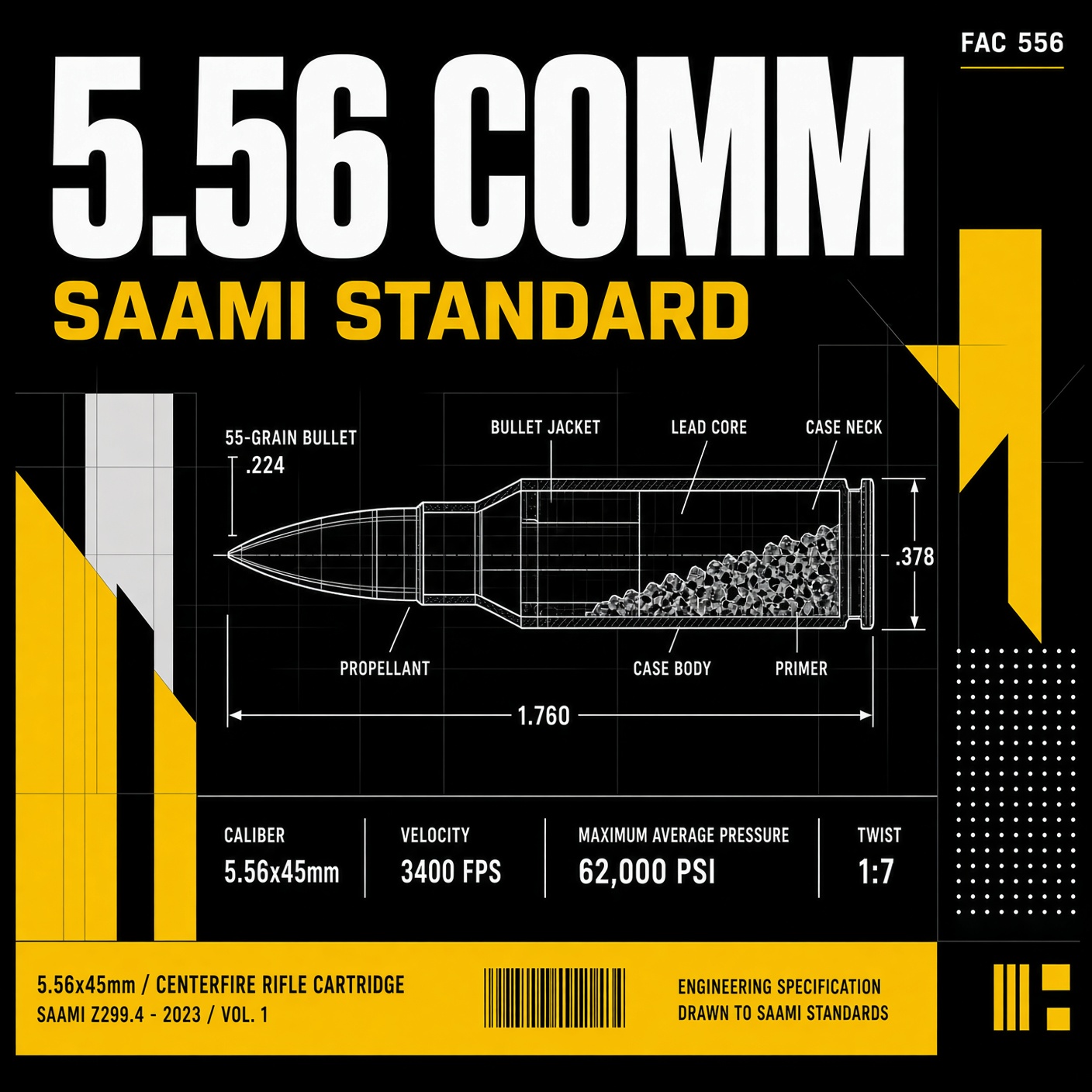
Yes. SAAMI (the Sporting Arms and Ammunition Manufacturers' Institute) has standardized the 5.56 Commercial cartridge, abbreviated 5.56 COMM or 556 COMM. Introduced by Hornady, it's a 55-grain load at 3,400 fps with a Maximum Average Pressure of 62,000 psi. For the first time, there's a publicly available commercial standard for what millions of rifles have been roll-marked for all along. The Firearm Blog broke it down, and SAAMI's own announcement confirms the details. The introduction package is dated June 22, 2026, with chamber drawings from June 9. It doesn't magically make everything NATO-compatible overnight — SAAMI is careful to note that conformance to this doesn't equal military or NATO specs, and there's still no publicly available standard for "5.56 NATO" itself — but it's a big deal for American citizens who own the most popular rifle in the country. Hornady Marketing Communications Manager Seth Swerczek noted to American Rifleman that the lack of public official specs for chamber dimensions, cartridge dimensions, pressure, and twist had caused confusion for manufacturers for years. This fills that gap from the commercial side.
So, grab a coffee (or something stronger), settle in, and let's walk through the history of this little cartridge that punches way above its weight. High school graduate level, with a healthy dose of humor and the occasional trademark spicy jab. Because education doesn't have to be boring, and the AR platform's story is full of ironies that write themselves. If you've ever wondered why your AR says 5.56 but the ammo box says .223, or why green tip exists, or how a Hollywood machine shop ended up arming the free world, this is the deep dive.
The Announcement: Education Mode Activated (For Once)
For decades, AR-15s have been chambered for 5.56mm. Walk into any gun store, and the vast majority of black rifles on the wall are marked 5.56 NATO, 5.56x45, or some variation. The cartridge itself traces its roots to the .223 Remington, which was the original commercial offering tied to the AR-15's development. They are dimensionally very similar — same case head, same overall length range, same .224-inch bullet diameter — and .223 Remington ammunition is generally safe to fire in a 5.56-chambered rifle. The reverse is where things get spicy.
A rifle chambered explicitly and only for .223 Remington can have issues with 5.56x45mm loads. The 5.56 chamber is a bit longer in the throat and freebore area to handle the higher pressures of military-spec ammo. Stuffing hotter 5.56 into a tight .223 chamber can spike pressures in ways that make your rifle (and your face) unhappy. SAAMI's guidance remains clear: any 5.56 ammunition in a chamber marked only .223 Remington is an unsafe combination. Check your rollmarks, folks. If it says .223 Rem only, stick to .223 or carefully vetted loads. If it's 5.56 or a Wylde chamber (a hybrid designed to safely shoot both, with a longer freebore like the 5.56 but tighter tolerances in other areas for accuracy), you're in better shape. This new 5.56 COMM standard doesn't change that fundamental safety rule — SAAMI is explicit about it. The 5.56 COMM is a voluntary standard; manufacturers aren't required to mark firearms or ammo with it, but it's acceptable practice. The test barrel is specified as 20 inches with six grooves and a 1:7 right-hand twist.
The fact that we're even talking about a commercial standard in 2026 is wild when you think about it. Millions of rifles, billions of rounds fired, and it took this long for a public civilian consensus standard. Hornady stepped up, SAAMI accepted it on October 12, 2026, and now there's a paper trail. Maximum average pressure 62,000 psi (versus 55,000 for .223 Rem), instrumental velocity of 3,400 fps with a 55-grain bullet in a 20-inch test barrel. Crusher pressure limits weren't established. It's not a NATO clone, and SAAMI won't promise blanket compatibility with existing 5.56 NATO products because those military standards aren't publicly available in the same way. But for American shooters, this is the closest we've had to "the people's 5.56." It's a recognition that the cartridge isn't just a military standard anymore — it's thoroughly civilianized.
From Hollywood to Helmand: The Roots of 5.56x45mm and the AR-15
The story starts in the late 1950s, with Eugene Stoner and the team at ArmaLite, a division of Fairchild Engine and Airplane Corporation. Here's the delicious irony that never gets old: they developed the rifle in Hollywood, California. Yes, the same Hollywood that today treats the AR-15 like it personally offended every celebrity's favorite alphabet mafia yoga instructor or caused their morning kombucha to rot. The original ArmaLite AR-15s even carried the rollmark "ArmaLite AR-15 / Hollywood, Calif. U.S.A." on early examples. Springfield Armory's collection has one marked that way (serial 000008), and early photos, brochures, and collector pieces show the Hollywood address clear as day. ArmaLite operated out of a small facility that looked more like a machine shop than a defense contractor — a leased space on Santa Monica Boulevard, more think-tank than factory. George Sullivan founded it as a subsidiary focused on lightweight modern materials. Stoner, a self-taught engineer and Marine veteran from Indiana who ended up in California, joined as chief engineer. He had no formal degree, but he had an aviation-industry mindset for weight savings and a deep mechanical intuition.
Stoner scaled down his earlier AR-10 (in 7.62x51 NATO) for the Small Caliber High Velocity (SCHV) program. The military, looking at data from WWII and Korea, wanted something lighter, with more ammo capacity per soldier, controllable full-auto, effective to about 300-500 yards, and the ability to punch a steel helmet at distance. They started with the .222 Remington as a base (a popular varmint and benchrest round), then Remington created the .222 Special (later renamed .223 Remington) to meet the velocity and pressure goals — roughly 3,250 fps with a 55-grain bullet using IMR4475 powder. Early testing in 1957-1958 showed the AR-15 prototypes performing better in some metrics than the heavier M14 contender. The Air Force adopted it early, and by 1963-1964 the Army was on board with the M16 and the cartridge designated Cartridge, 5.56mm Ball, M193. Remington commercialized the .223 Remington around the same time as a sporting round. The original M193 was a simple 55-grain full metal jacket with a lead-alloy core and copper jacket, optimized for the 1:12 twist of the early M16's 20-inch barrel. It worked great when it stayed above the velocity threshold where it would yaw and fragment in tissue (roughly 2,700 fps or so). Below that, it could icepick through like a pencil, which is why shorter barrels later caused complaints.
The platform expanded internationally as the M16 (and later variants) saw service in Vietnam and beyond. Foreign NATO forces, being on the metric system, naturally referred to it as 5.56x45mm. The U.S. Army adopted the designation in 1963. Hollywood's contribution to the most hated/loved rifle in modern America is one of those facts that writes its own punchline. Stoner and company were solving practical problems with aluminum receivers, plastics, and a clever direct impingement gas system (where gas is tapped from the barrel and directed back to the bolt carrier) in a California shop, not plotting to arm every suburban dad or create a cultural flashpoint. The irony is thick enough to cut with a bayonet — or a Hollywood prop one.
Early civilian versions appeared quickly. Colt, after buying the rights from ArmaLite in 1959, introduced the semi-automatic AR-15 Sporter (SP1) in 1964, chambered in .223, as the civilian counterpart. It came with 5-round magazines initially to satisfy the "sporting" market of the day. For years, it was a niche rifle for enthusiasts who appreciated the lightweight design and accuracy potential.
Going Metric, NATO, and Why M193 Started Losing Favor: SS109, M855, and Friends
As the AR platform spread (usually as the M16), NATO wanted standardization. In the 1970s, they ran trials for a second standard cartridge to complement (and in many cases replace for infantry use) the 7.62x51. The U.S. had already diverged with the 5.56, and the Alliance wanted one common intermediate round. FN Herstal in Belgium developed the SS109 — a 62-grain bullet with a steel penetrator tip in the forward portion and lead core behind it. It offered better long-range performance thanks to a higher ballistic coefficient, better penetration against helmets and light barriers (capable of punching a steel helmet at 600 meters in testing), and required a faster twist rate (1:7 or 1:9) to stabilize the longer projectile and its tracer cousin (L110, which became M856 in U.S. service). NATO adopted it in 1980 under STANAG 4172 as the 5.56x45mm NATO standard. The U.S. adopted it as the M855 in 1982, painting the tip green so troops could tell it apart from the older M193. The M16A2 came with the 1:7 twist to handle it properly.
Why did M193 fall out of favor for professional use? Real-world feedback, especially from Vietnam and later conflicts, showed limitations. The lightweight 55-grain bullet could have trouble against barriers like car doors, vegetation, plywood, or light cover, or at longer ranges once velocity dropped and it stopped fragmenting reliably. It was optimized for the full-length M16 barrel. When troops started using shorter carbines, performance suffered — lower muzzle velocity meant less reliable yaw and fragmentation in tissue. Complaints about "icepicking" through soft targets without significant wounding were common if the velocity wasn't high enough. The steel tip on the SS109/M855 improved barrier penetration and consistency at distance. Tests showed better helmet penetration (yes, boom headshot) at extended ranges, and it paired well with the M249 SAW and the M16A2. M193 didn't disappear overnight — it still has fans for its terminal effects at close range when it fragments aggressively (some argue it's more effective against unarmored soft targets at velocity than the tougher M855) — but the military moved on for standardization and improved capability against the threats of the day, including potential adversaries with better helmets and light armor. The transition also required barrel changes; old 1:12 twist barrels didn't stabilize the heavier 62-grain projectile well.
There's a "gray area" side of this story with true armor-piercing rounds like the M995. The M995 is a dedicated AP load with a tungsten core, developed in the 1990s under the Soldier Enhancement Program for better performance against lightly armored vehicles. It's black-tipped and very effective at punching steel at extended ranges. The M993 is the 7.62 counterpart. Here's the humorous but important legal reality: most rifle calibers can technically get through some kinds of armor or barriers under the right conditions. Velocity and construction matter a lot — a fast 55-grain M193 can defeat some steel plates that stop slower green tip under certain circumstances. But "armor piercing" in U.S. law is a specific statutory definition under 18 U.S.C. § 921(a)(17). It generally covers projectiles or cores that may be used in a handgun and are constructed entirely of certain materials (tungsten alloys, steel, iron, brass, bronze, beryllium copper, or depleted uranium), or full-jacketed projectiles larger than .22 caliber designed for handgun use with a jacket over 25% of the weight. There's a sporting purposes exemption that the Attorney General (via ATF) can apply, plus exceptions for shotgun shot required by game regulations, frangible target rounds, and industrial uses. You can read the exact language here. Federal law restricts manufacturing, importing, and commercial sale of true AP ammo to civilians (supply-side controls under the Gun Control Act), but mere possession of lawfully acquired rounds isn't banned federally. State laws vary.
M855/SS109 got a sporting purposes exemption early on (1986) because its core isn't "entirely" steel (there's lead behind the penetrator), and it was intended for rifle competition and sporting use. ATF even clarified in 2026 that the projectiles and cores themselves fall under that exemption. M995 is different — true tungsten core AP — and falls under the restrictions. Most people don't need to worry about this; the common green tip is fine and widely available. The point is that the law is narrower and more specific than "anything that can pierce armor," which is good, because otherwise a lot of hunting rounds and high-velocity rifle ammo would be in trouble. If every round that can defeat soft body armor or light steel was banned, the shelves would be empty of most rifle calibers.
Civilian Adoption, Expired Patents, and the Ban That Accidentally Made the AR-15 America's Rifle
AR-15s started appearing in civilian hands early. Colt introduced the semi-automatic AR-15 Sporter (SP1) in 1964, chambered in .223, as the civilian counterpart to the military M16. It was marketed as a sporting rifle, and early production numbers were modest — a few thousand per year in the mid-to-late 1960s. For years, Colt had the market largely to itself thanks to patents. The core patents (including Stoner's gas system patent, U.S. Patent 2,951,424, filed 1956/1957 and granted 1960) expired around 1977. That opened the door for third parties to build compatible rifles and parts without royalties. Companies like Olympic Arms, Eagle Arms, and later Bushmaster, DPMS, and others started offering clones and variations. The ecosystem of parts and complete rifles grew slowly at first, then accelerated.
Then came the 1990s and the term "assault weapon." Josh Sugarmann of the Violence Policy Center popularized it in a 1988 paper titled "Assault Weapons and Accessories in America," openly noting that the "menacing looks" of semi-autos, coupled with the public's confusion over fully automatic machine guns versus semi-automatic "assault weapons" — anything that looks like a machine gun is assumed to be a machine gun — can only increase the chance of public support for restrictions. Few people, he argued, could envision a practical use for them. The history of the term is well-documented, and Sugarmann's strategy was explicit about exploiting optics and confusion. The 1989 Stockton school shooting amplified the rhetoric. The 1994 Federal Assault Weapons Ban (Title XI of the Violent Crime Control and Law Enforcement Act, effective September 13, 1994) banned by name certain models (including the Colt AR-15, Steyr AUG, UZI, etc.) and used a features test: semi-automatic rifles with detachable magazines plus two or more "evil" features like a pistol grip that protrudes conspicuously, flash hider or threaded barrel, folding or telescoping stock, bayonet mount, or grenade launcher. Magazines over 10 rounds were also restricted for new manufacture. Pre-ban guns and magazines were grandfathered — you could keep and transfer them.
The ban expired in 2004 after Congress declined to renew it. NIJ-funded studies found no measurable impact on crime rates; assault weapons were rarely used in crimes even before the ban, and post-ban compliant rifles (thumbhole stocks, no flash hider, pinned stocks) filled the gap. The ban itself had the opposite effect of what its supporters intended for the AR platform. Demand for "pre-ban" configurations skyrocketed, driving up prices dramatically in the secondary market. Manufacturers adapted with compliant versions almost immediately — remove one feature and it was legal. When the ban lifted, people who had spent a decade hearing that these rifles were uniquely dangerous and "military-style" went out and bought them in huge numbers. Combined with the post-patent explosion of manufacturers (prices dropped as competition increased and CNC made production easier), the platform's modularity (one lower, many uppers for different roles), common and relatively affordable ammo, low recoil for follow-up shots, accuracy potential even in basic builds, and ease of customization with aftermarket parts, the AR-15 went from a niche rifle to the most popular centerfire rifle in the United States. Estimates put civilian ownership of AR-style rifles in the tens of millions today. The ban jumpstarted awareness and purchasing more than it suppressed it. Funny how that works — the government tried to make them scary and rare, and instead made them famous and ubiquitous. NSSF data and industry tracking show the explosion in production and sales after 2004, turning what was once a specialized sporting rifle into a mainstream tool for everything from home defense to competition to hunting.
The Modern Era: M855A1, Mk 262, Mk 318, and What You Should Actually Buy for Defense
Military development continued into the Global War on Terror era. The M855A1 Enhanced Performance Round (adopted by the Army around 2010 after years of development, including efforts to go lead-free) is the current general-purpose load. It's a lead-free design with a solid copper slug and an exposed steel penetrator tip, designed for better consistency across temperatures and ranges, improved barrier performance (it can defeat light steel at longer distances than M855 in testing), and reduced environmental impact from lead in the waste stream. It's loaded hotter in some accounts and optimized for the M4's shorter barrel. It's a bit of a legal gray area for civilians — not widely commercially produced for the public market because of proprietary design rights held by the government and restrictions on Lake City overruns. You might see surplus or pulled rounds on places like Gunbroker, often at a premium. Exercise caution: verify the seller carefully, understand what you're getting (military surplus vs. something else), and know that true military M855A1 isn't sitting on the shelf at your local big-box store like green tip. It's not automatically "illegal" to possess or shoot if lawfully acquired, but the commercial channel is limited, and you don't want to end up with something misrepresented or potentially problematic under state laws. The Army describes it as not an armor-piercing round in the statutory sense, but the steel penetrator and construction put it in a gray zone compared to pure lead-core loads.
On the special operations side, Black Hills developed the Mk 262 (working with the Army Marksmanship Unit and later Navy/SOCOM) starting in the late 1990s for the Mk 12 Special Purpose Rifle. SOCOM wanted a precision load accurate out to 600 yards for the SPR concept. It's a 77-grain Sierra MatchKing open-tip match (OTM) load, militarized with proper primer seals, crimps, and flash suppressant powder. Mod 0 was adopted in 2002; Mod 1 with a cannelure on the bullet came around 2003 for better reliability in dirty or cold conditions, especially from the 18-inch SPR barrel. An early two-man SOF team reportedly achieved remarkable results with it. Excellent accuracy (sub-MOA capable) and terminal performance from carbines due to the open tip and higher BC. The Mk 318 (SOST — Special Operations Science and Technology) came later from NSWC Crane Division with Federal Cartridge involvement — a 62-grain barrier-blind open-tip design with a copper slug behind the lead, adopted by SOCOM around 2007 and used extensively by the Marines (who preferred it over M855A1 in some contexts for terminal effects). These were responses to real-world feedback from Iraq and Afghanistan where standard M855 wasn't ideal against the threats and barriers encountered (windshields, walls, car doors), especially from short barrels where velocity dropped and fragmentation was inconsistent. The Marines and Army famously had some divergence on preferred loads before standardization pressures.
For civilians, there are excellent commercially available 5.56x45mm options suitable for defensive use from Speer, Black Hills, Winchester, Hornady, Federal, and Nosler. Speer Gold Dot in 62-grain or 75-grain bonded soft point is a classic LE-proven duty load — the Uni-Cor bonding process keeps the core and jacket together for barrier performance (auto glass, drywall, heavy clothing), controlled expansion (often in the 0.6-inch range in gel), and high weight retention. It shows up in many agency contracts and has a strong street record. Black Hills has dual-purpose loads with Barnes TSX (solid copper, excellent expansion and weight retention, lead-free, good for both hunting and defense) or their own offerings, plus the commercial versions of the Mk 262 style 77-grain OTM (often labeled MOD 1-C or similar) that double as excellent defensive rounds with proven terminal effects from the open tip and high ballistic coefficient. Hornady TAP (Tactical Application Police) loads, including 75-grain BTHP options that fragment reliably for rapid energy dump, Critical Defense/Duty style with FlexLock tips, and InterLock designs that mechanically lock the core. Federal Fusion (bonded core) or Tactical Bonded soft points, and their XM193/XM855 for affordable training. Winchester has duty-oriented loads and Ranger series that agencies trust. Nosler with Ballistic Tips (polymer tip for rapid, violent expansion on varmints or soft targets) or other expanding designs that work well for hunting and can double for defense. Many hunting rounds in 5.56 (varmint loads with V-Max style tips or medium game loads) are outstanding for defensive use because they expand rapidly, dump energy in the first several inches, and reduce over-penetration risk compared to pure FMJ. The key is matching the bullet construction to the expected engagement — rapid expansion for unarmored threats at home, bonded for potential barriers.
A solid starting point is common law enforcement duty loads in 5.56. Cops face similar threats to what armed citizens do — humans at typical engagement distances (often inside 50-100 yards for home defense), sometimes with intermediate barriers like walls or vehicle glass. If a load has a proven street record with agencies (Speer Gold Dot, certain Federal and Hornady loads, Black Hills options show up frequently), it's a good place to begin your research. Test in your rifle, of course — velocity from your barrel length matters, as does reliability in your specific gun. The threats aren't identical to a full-scale infantry fight against body armor at 500 yards, so the loads optimized for that (like pure steel-core penetrators) aren't always the best for home defense. Fragmenting or expanding loads that perform well in ballistic gelatin and barriers tend to be preferable for most civilian defensive scenarios. Match your ammo to your twist rate (1:7 or 1:8 for heavier 69-77 grain bullets), barrel length, and intended use. And always prioritize reliability and accuracy in your particular rifle over marketing claims.
Wrapping It Up: Decades Old, Still Growing, and Now Officially Standardized
We've covered a lot of ground. The 5.56x45mm started as the .223 Remington tied to Eugene Stoner's Hollywood-born AR-15, became the military M193 for the M16 in Vietnam, evolved into the NATO SS109/M855 standard in 1980 for better long-range and barrier performance (with the green tip becoming iconic), spawned specialized loads like the Black Hills Mk 262 for precision and the Mk 318 SOST for barrier-blind SOF use, and now has a formal SAAMI commercial standard as 5.56 COMM thanks to Hornady and the industry consensus process. Along the way, expired patents in the late 1970s opened the floodgates for clones, the 1994 Assault Weapons Ban (with its features test and magazine restrictions) backfired spectacularly by raising awareness and demand, and the platform's modularity and low cost of entry turned the AR-15 into America's rifle. The cartridge is decades old, but it's still growing — new loads from commercial makers, better components, improved powders, and now a public civilian standard that acknowledges what millions of owners already knew and used every day.
5.56 isn't magic. It has limitations (especially from short barrels where velocity drops and terminal effects suffer, or against certain hard armor at distance), and bullet selection matters enormously — FMJ for practice, expanding or fragmenting for defense. But for the vast majority of armed citizens, a well-built AR in 5.56 with appropriate defensive ammo is an outstanding tool for home defense, training, and recreation. The SAAMI standardization of 556 COMM is a quiet but important milestone: the cartridge that defined a generation of rifles now has clearer commercial guidelines for American manufacturers and shooters. Check your chamber markings carefully, pick quality ammo matched to your use case and rifle, and train regularly. The history is fascinating, the ironies are rich (Hollywood origins, the ban that created a market), and the practical result is that the most popular rifle in the country is better supported than ever. Whether you're running a classic 20-inch rifle or a modern carbine, the 5.56x45mm has earned its place. From the early ArmaLite prototypes that weighed barely over six pounds loaded to the modern modular builds with free-float handguards, optics, and suppressors, the cartridge has scaled with the platform. The new commercial standard doesn't rewrite the past, but it gives manufacturers and shooters a clearer, publicly available reference for the future. In a world where the AR-15 is the default modern sporting rifle for millions, having SAAMI lock in 556 COMM feels like the logical next chapter after decades of informal practice and military specs that weren't fully transparent to the civilian market.
If you want more deep dives like this (or the usual spicy 2A analysis with the politics dial turned up), you know where to find me. In the meantime, the 5.56x45mm story continues — and now it has an official civilian chapter. Stay safe, stay armed, and check those rollmarks.
note: I wrote this with the aid of Grok. Let me know what you think. With Grok I can output faster, but it may not seem like "me" as much. Without Grok, you get "me" but slower.
Get Yourself A Gun And Learn It
This is a firearms blog, so we're going to recommend guns. Of course don't forget other things like medical, comms, doing your Area Study, and so on. There's better sources than RGG on those topics, but for firepower, we have you covered.
Ideally you'll at least want either a basic rifle, i.e. an AR-15, or a pistol, i.e. a GLOCK 19, to start. Both are exceedingly common firearms with plenty of accessories, spare parts, training, and support. However, in some restricted areas, both an AR and a GLOCK are hard to get easily, and you may have to settle for a shotgun for quickly arming yourself. It beats a sharp stick. Note, the in-house counsel wants to remind you that we're talking the legal acquisition of guns here. We're still working on abolishing gun control, and we don't want you in jail. Unfortunately you'll have to play ball in this regard. But anyways, here are some basic suggestions for getting armed.
| Firearm | Cost | Buy Now |
|---|---|---|
| Radical Firearms RF00028 AR-15 | $469 | Buy Now! |
| GLOCK 19 Gen6 9mm Pistol | $620 | Buy Now! |
| Mossberg 590 Shotgun | $621 | Buy Now! |
Learn how to make guns, as well.
| 3D Printer | Cost | Buy Now |
|---|---|---|
| Ender Creality 3 V3 SE | $186 | Buy Now! |
Support This Site
Operating Regular Guy Guns and bringing you quality content costs money, money that I am more than happy to spend, even after all these years! I get the occasional sponsor, but bills still have to be paid, ha ha.
You'll see the articles peppered with affiliate links. I get a few pennies when you make your purchases via my links.
-
Buy more guns at Palmetto State Armory
-
Buy more guns at Bear Creek Arsenal
-
Buy more guns at Brownells
TODO
Broken links in old articles
Addendums to old stuff
Buy more guns and make more guns
Podcast? AI killed the podcast.
Donate Bitcoin: 36wKfH7wgQQna6BByvAe8oiEmdqREUXuYQ