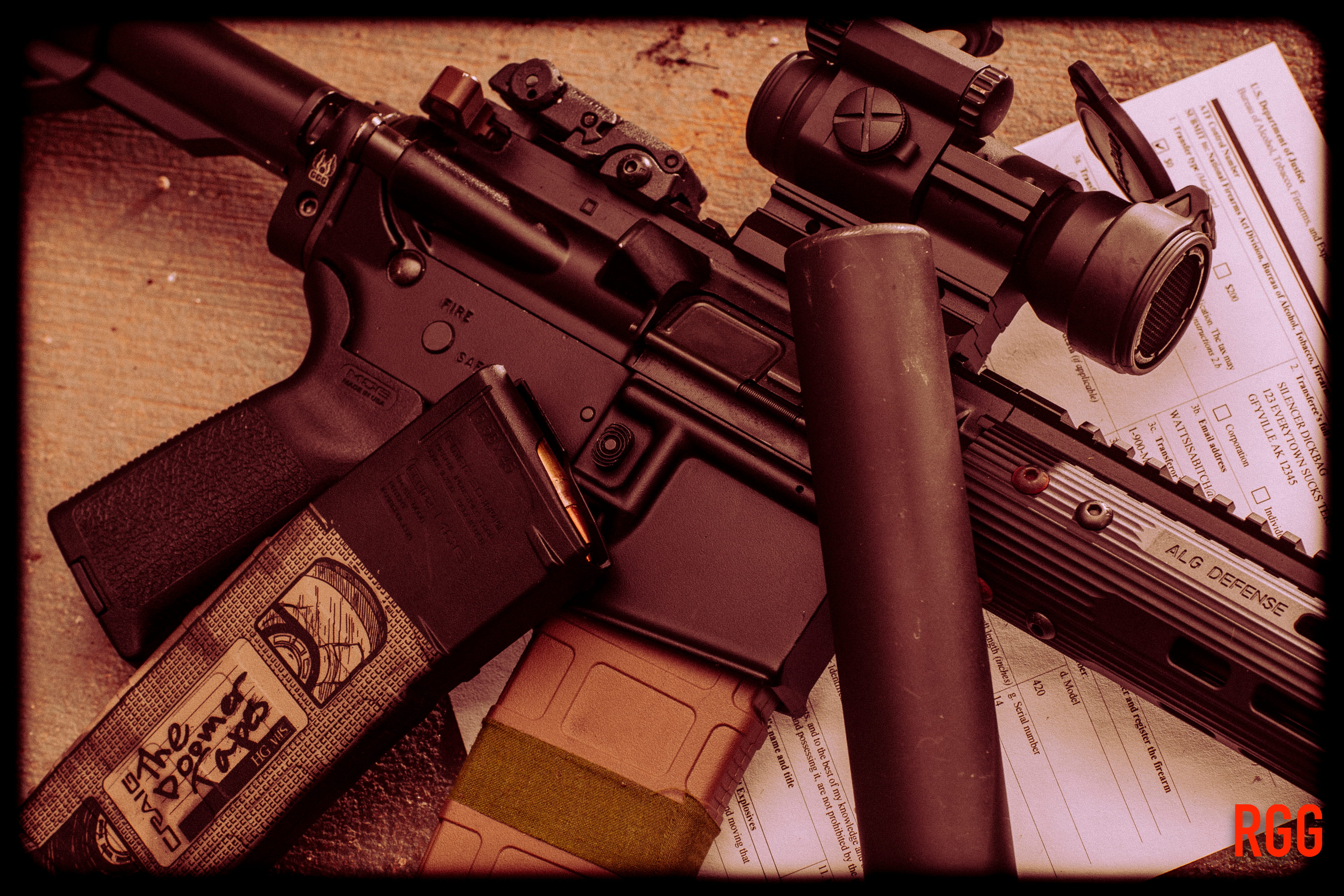
The ATF Got Hacked And Wants You To Take Their Word For It
The Bureau of Alcohol, Tobacco, Firearms and Explosives just confirmed a “major” cybersecurity incident. A ransomware crew called Qilin is taking credit for the attack. The ATF says the box that got punched was “isolated.” They will not tell you which box. They will not tell you when they found it. They will not tell you whether anything walked out the door. They will tell you, with the serene confidence of a man selling flood insurance in a hurricane, that the National Firearms Registration and Transfer Record was not touched, that eForms was not touched, and that none of the “critical” systems were touched.
Trust them, bro.
That is not a press release. That is a hostage note written by the hostage-taker. And if you own a firearm in the United States of America — a single-shot .22 in a sock drawer, a GLOCK on the nightstand, a transferable machine gun, a crew-served souvenir that some ancestor brought home and some lawyer later papered, or anything in between — you are the payload. Not the ATF’s pride. Not some contractor’s SLA. You. Your name. Your address. Your serial numbers. The map of a civilian inventory that is, in the only sense that matters to a hostile intelligence service, a standing army that does not report to the Pentagon.
Gun Owners of America broke the news and said the quiet part out loud: the ATF sits on a pile that looks a lot like a registry of more than a billion guns and hundreds of millions of gun owners. Congress has been asking the same question for years - what data does the bureaucracy collect on gun owners? In 2021 the agency admitted it was sitting on about 921 million out-of-business records, the vast majority already digitized. Members of Congress later warned the number could be north of a billion if the scan-and-stack operation kept its pace. The ATF’s answer to a ransomware gang showing up on a leak site is the same answer it gives Congress: isolated system, nothing to see, please disperse.
Second Amendment Radicals already know the punchline. Normie gun owners need to hear it without the polite filter. A list of who owns what is not a public-safety tool. It is a targeting manifest. Foreign reconnaissance teams would kill for a clean dump of American civilian arms. A rogue employee with a USB stick and a political hobby could dump the same folder onto any dark-web stall before lunch. The government that built the list has spent decades proving it cannot keep a secret, cannot keep a database honest, and has no institutional incentive to do either — because the list is not there to protect you. The list is there to find you. For these reasons, the NFRTR, the NFA, and NICS must be abolished and replaced with nothing. No data collected, no data to hack.
This is the emergency. The rest of this piece is the autopsy.
🚨UPDATE🚨
— Gun Owners of America (@GunOwners) August 26, 2026
ATF confirms a “major incident” occurred, but denies any registration system breach, including NFA eForms.
“Upon discovery of the incident, ATF immediately terminated connections to the affected environment and initiated incident‑response and forensic activities.”
What They Admitted, And What They Hid Behind “Isolated”
On August 26, 2026, GOA posted that Qilin claimed the ATF was part of their recent data haul. Hours later the bureau put out a statement that reads like it was written by a lawyer who had just discovered the word “environment.”
According to contemporaneous reporting, the Department of Justice labeled it a “major incident.” The ATF said the affected system sits apart from the enterprise network. It said there is “no indication” the incident touched the broader network, the eForms system, or “any other ATF system.” It said that upon discovery it “immediately terminated connections to the affected environment and initiated incident-response and forensic activities.”
Read that again. They will name the category of the event. They will not name the system. They will not say whether data left the building. They will not say how long the adversary was inside. They will not invite an independent auditor. They will not publish indicators of compromise for the public that just financed the computers.
That is the “trust me bro” model. In any other industry it would be a class-action lawsuit and a congressional hearing if the company were public. In Gun Control, Inc, it's just Wednesday.
GOA’s first post is here. The follow-up is here. The ATF’s own page is here. Fox and others confirmed the “major incident” language and the refusal to identify the box. If your first instinct is “send an FOIA and demand an independent audit,” congratulations: you are already more serious about this than the people who built the list.
The NFRTR is the jewel. It is the only overt federal registry of privately held firearms — machine guns, suppressors, short-barreled rifles and shotguns, destructive devices, “any other weapons.” The ATF wants you to believe that jewel sits in a vault so sacred that a “major incident” elsewhere cannot even fog the glass. Maybe that is true today. Maybe it is a press-office bedtime story. You cannot know, because they will not let you know. That is the point of a secret list. The custodian always claims the lock is fine. The lock is never the part that fails first. The human is.
The Civilian Inventory Is A Military Fact, Not A Hobby Statistic
Start with the pile.
The late Kevin “Hognose” O’Brien at WeaponsMan used the kind of estimate working gun people actually use when they stop pretending survey respondents tell the truth: 600 million-plus civilian firearms in American hands. The Small Arms Survey’s 2017 figure — about 393 million — was already the largest civilian stockpile on Earth, larger than the next two dozen countries combined, and it is a floor, not a ceiling. ATF production data since 1899 now runs toward half a billion guns manufactured for the U.S. market. Attrition is real. Under-counting is more real. Privately made firearms are real. Estate guns that never saw a 4473 are real. The number that matters for an intelligence officer in Beijing, Moscow, Tehran, San Francisco, or a domestic NGO with a flash drive is not the press-friendly survey. It is the order of magnitude. Hundreds of millions of weapons, from a Heritage .22 to transferable and post-sample machine guns to NFA destructive devices that include items most people only see in a field manual or on Brandon Herrera's social media.
That mass is not a metaphor. It is a military fact. No foreign army on the planet can occupy this country against a hostile, armed population of that size. No domestic political project that requires door-to-door collection can do it either, unless it first knows which doors. A registry is how you turn a nation of armed citizens into a spreadsheet of addresses. A breach is how that spreadsheet leaves the building. Coupled with modern AI tools, this is a real threat. Even if the NFRTR or NICS data wasn't fully exfiltrated, artificial intelligence can fill in the blanks and make disparate data into action items.
Imagine you are a hostile foreign service. You do not need every serial number tomorrow. You need the shape of the force: where the density is, which households hold NFA items, which dealers sit on inventory, which names match other leaked sets (OPM, Equifax, AT&T, the last hospital ransom dump). You need reconnaissance. A centralized file at ATF is reconnaissance with a government letterhead.
Now imagine you are not a foreign service. Imagine you are a single employee with a grievance, a morally bankrupt ideology, and a cheap external drive. The 1998 Treasury Inspector General review of the NFRTR found unauthorized access by people who were no longer employed. That is not a hypothetical from a thriller. That is an audit finding. Portable storage devices have gotten smaller and denser since 1998. Motivations have not.
“Gun registration is the first step toward ultimate and total confiscation, the first step in a complete destruction of a cornerstone of our Bill of Rights.”
— Sen. James A. McClure (R-ID), sponsor of the Firearm Owners’ Protection Act
McClure put that ban in the statute for a reason. The people who built the backdoor list have spent forty years pretending the statute was a suggestion.
The NFRTR: Paper, Microfilm, Fantasy Accuracy, And A Database That Ate Itself
If you have never stared into the National Firearms Registration and Transfer Record, here is the short version: it is old, it was analog for most of its life, the digitization was a mess, the error rate has been a running joke inside the industry for decades, and the government still uses it to put people in prison.
The NFA of 1934 created a tax-and-registry scheme. For a long time the “record” was paper. Then microfilm. Then a series of databases that did not talk to each other cleanly. When ATF merged an old NFRTR with a new one in the late 1990s, the Treasury IG found ATF could not prove the reconciliation. ATF told auditors it had reconciled the two databases in September 1997 and kept no record of the reconciliation. Later ATF admitted 407 entries from the old database were missing from the new one — the ones they knew about. Work papers from that era described a variance of more than 200,000 weapons between two official reports. Weapons registered to dead people. Remittance checks left unsecured. Former employees still able to get in.
That is not “state of the art.” That is a filing cabinet with a login screen glued to the front.
The 2007 Department of Justice Office of the Inspector General review — Evaluation and Inspections Report I-2007-006 — is the document every NFA owner should have bookmarked. OIG found that NFA Branch staff did not process applications or enter data consistently. The Branch itself considered the software programming flawed. Older records with empty fields dropped out of searches. The system could spawn two records for one weapon. A change entered for one gun on a multi-weapon form could smear across every gun on that form. Queries listed the wrong owner. There was a backlog of discrepancy reports with no deadline to fix them.
Then OIG surveyed the Industry Operations Investigators who actually walk into shops. 46.5 percent said they found a discrepancy between the NFRTR inventory report and a licensee’s inventory “always” or “most of the time.” 44.4 percent said the discrepancy was an NFRTR error “always” or “most of the time.”
NFA Branch Chief Thomas Busey, in remarks that have been chewed over in litigation for years, described an error rate in the neighborhood of 49 to 50 percent before he took the job in the early 1990s. He also noted the obvious: if the database were clean, you could type a name and know whether that person had a Title II weapon. They could not do that. They still prosecuted people anyway.
The NFA Trade and Collectors Association later fought FOIA wars just to get aggregate counts of transferable machine guns, with ATF warning that because records arrived by different methods across different decades, any total came with a margin of error. Accurate enough to convict you. Too sloppy to count.
Has the NFRTR itself been “hacked” in the Hollywood sense, with a crew dumping the whole file on a leak site? There is no confirmed public incident that matches that description. Do not take comfort from that sentence. Take the opposite. A system that spent most of its life as paper and microfilm, then as a flawed internal database with documented unauthorized access by ex-employees, is not a system with a public scoreboard. Absence of a press release is not absence of a compromise. It is absence of sunlight. The same agency now asking you to trust an unnamed “isolated environment” is the agency that lost 407 records in a migration and shrugged.
A rogue employee does not need Qilin. A rogue employee needs a badge, a query tool, and a reason. The 1998 IG already documented the badge problem. The reason writes itself in any year that ends with an election.
What is it running on now? ATF does not publish a useful architecture diagram for the public, which is convenient. Historically the NFA world has lived inside ATF’s National Firearms Act System / NFRTR application stack, later tied to eForms for submissions. GAO’s 2016 review of ATF firearms-purchaser systems listed “National Firearms Act System / National Firearms Registration and Transfer Record System” among the systems that contain retail purchaser information. Closed, they say. Segmented, they say. Isolated, they say. Every ransomware after-action report in the last decade begins with someone saying the same three words about the box that actually got hit.
The Backdoor Registry They Swear Does Not Exist
FOPA was not subtle.
“No such rule or regulation prescribed after the date of the enactment of the Firearms Owners’ Protection Act may require that records required to be maintained under this chapter or any portion of the contents of such records, be recorded at or transferred to a facility owned, managed, or controlled by the United States or any State or any political subdivision thereof, nor that any system of registration of firearms, firearms owners, or firearms transactions or dispositions be established.”
— 18 U.S.C. § 926(a)
Congress said no registry. ATF built one out of spare parts and called it “tracing.”
Out-of-business records. When an FFL dies, retires, or gets zero-toleranced out of existence, the bound books and 4473s go to the National Tracing Center. For decades that was a mountain of paper. Then it became a scanning operation. GOA’s document haul showed ATF “processing” on the order of 55 million out-of-business records in a single year. A 2021 ATF figure put the pile at 920,664,765 OBR, of which 865,787,086 were already digitized. Reason and others have used the ~866 million digitized figure in public. House members in 2025–2026 were still demanding an updated count and warning the digitized stack could have crossed a billion. ATF’s public line is that OBRIS images are not “name searchable.” Anyone who has watched a government contractor run OCR, build an index, or just Ctrl-F a folder of PDFs knows how much comfort that sentence is worth. “We pinky-swear we did not build the search box” is not a security control.
NICS inquiry data. A NICS check is not supposed to become a gun owner list. In practice, multiple-handgun sales reports flow to ATF as a matter of course. Border-state multiple-rifle reports do too. NICS denials generate law-enforcement notifications. Retention rules exist on paper. Mission creep exists in buildings. That is why a “trust us, the NFRTR was not in the blast radius” statement is not enough. The NICS apparatus — the checks, the delay files, the deny referrals, the audit logs, the interfaces between FBI and ATF — is another pile of gun-owner-adjacent data sitting on federal iron. If you are going to audit one list, you audit that one too. With Palantir basically building a single-pane-of-glass AI fusion center for FedGov, it's a real threat to Second Amendment Radicals. Sidebar: Tech bros are not your friend, gun owners.
Industry Operations Investigators and the cell-phone photocopier. In 2022, Black Metal Firearms in Arizona filmed an IOI photographing entire A&D books with a phone app that reads text. Names, addresses, serials, sellers. GOA FOIA’d the Industry Operations manual. ATF’s own rules limit copying to specific violation evidence, logged on a property receipt. Wholesale copying of bound books is how you build a registry one inspection at a time without ever passing a law that says “registry.” AmmoLand’s write-up of that incident is here. If you think that was the only shop, you have never met an IOI with a quota, a grudge, and a government Samsung. IOIs typically hate the Second Amendment. Additionally, if you choose to keep your books in paper format, they will find an excuse to flag you and digitize your entire repository, on pain of death.
Multiple sales and eTrace. Form 3310.4 is a name-and-gun report by design. eTrace lets thousands of departments query the tracing apparatus. The more of the commercial chain that lives in one agency’s basement, the less “federated” the old 4473 system really is.
Stack that on top of the NFRTR and you do not have “tax records plus a tracing service.” You have a de facto national firearms registry assembled in violation of FOPA, dressed in the clothing of criminal investigation.
Jensen v. ATF and the companion Silencer Shop Foundation case just kicked the last fig leaf off part of that structure. On August 5, 2026, Judge James Wesley Hendrix in the Northern District of Texas held that once Congress zeroed the making and transfer taxes on suppressors, SBRs, SBSs, and AOWs, the NFA’s registration scheme for those items could not hide under the taxing power anymore. Registration that exists to collect a tax that no longer exists is not a tax. It is a list. The injunction is party-limited and the fight is not over. The principle is not subtle: large pieces of the NFRTR are no longer “for tax purposes.” They are a catalog of citizens.
The 4473 Was Always A Registry. The Cloud Just Made It Fast.
The gun-control priest class loves to say there is no federal registry because the 4473 lives at the shop. Cute. That is a federated registry with a latency problem.
A Form 4473 is a federal firearms transaction record with your name, address, ID, and the gun’s vital statistics. The bound book is the index. When ATF wants a trace, it calls the manufacturer, walks the wholesale chain, and lands on a dealer. In a live shop that can take days. “Days” is slow if you are used to Google. “Days” is lightning if you are a prosecutor building a case or a political actor building a list. ATF brags that it traces most recovered crime guns in a short window. That capability is the point of the system. Calling it “not a registry” because the first lookup is a phone call is like calling a library “not a catalog” because the card file is in another room.
Now put the bound book and the 4473 in FastBound, Orchid eBound, e4473 Cloud, 4473 Cloud, or the next tech-bro vibe coded slop project. Tens of thousands of FFLs already did. One vendor boasts a billion-plus transactions processed. Another processes tens of millions a year. The pitch is compliance and speed, and a lot of honest dealers need both. The architecture is a third-party database of gun buyers, sitting on somebody’s cloud, reachable with credentials, reachable by a bad actor in the data center, vulnerable to the same ransomware economy that just spray-painted the ATF’s name on a leak site. ATF still has to “ask” in theory. In a world of out-of-business scans, phone-photographed A&D books, compliant stooges in the tech sector, and cloud exports, “ask” is a courtesy.
A trace that used to take a week is a query that takes a coffee. That is still “actionable.” Combined with FOPA’s plain text, it is still the thing Congress banned. The only upgrade is the access time.
California Already Dropped The Folder On The Floor
You do not need a thought experiment. You have California.
In June 2022 the California Department of Justice launched a “Firearms Dashboard Portal” to celebrate transparency. For roughly twelve hours it published a spreadsheet of concealed-carry applicants and holders. Names. Dates of birth. Genders. Races. Driver’s license numbers. Addresses. Criminal history fields. People granted and denied over a decade. Investigators later said personal information on about 192,000 people was downloaded 2,734 times from 507 unique IP addresses. The Assault Weapon Registry, DROS, Firearm Safety Certificate, and GVRO dashboards were also in the blast radius. AP’s summary is here. Wired is here. No friend of 2A, both publications were sharply critical of California's behavior. The outside law firm’s verdict was incompetence, not a mastermind: an under-trained analyst, bad procedures, supervisors who did not look.
That is the malevolent, well-funded, proudly anti-gun jurisdiction. They doxxed their own carry permit holders by "accident" and then offered credit monitoring, as if a leaked CCW roster is a stolen credit card and not a shopping list for every burglar and political enforcer in the county.
California also hands firearms data to “accredited” researchers. AB 173 and related statutes require DOJ to share Automated Firearms System and related records with the UC Davis Firearm Violence Research Center and, with process, other nonprofit research shops. A trial court tried to stop it on privacy grounds. A state appellate court put the sharing back on in 2023, because “research.” Read the Chronicle’s account here. Even if every graduate student is a saint — and they are not — you have now copied a gun-owner file out of the “secure” government silo and into university IT, where the average security culture is a shared password on a sticky note. SOC 2 compliance? Those kids probably think it has something to do with the pile of laundry in their dorm. The state that cannot keep a dashboard from dumping 192,000 home addresses wants you to believe the next copy will be fine.
New York Does Not Need A Hack. It Has A Policy.
Registries do not have to leak to hurt you. Sometimes the government just uses them.
New York’s pistol license has always been a registry with extra steps. The SAFE Act added recertification: log into a State Police portal, list every pistol and revolver on the permit, update the household, and hope the website works. Fail the ritual and the permit dies. ERPOs and household-member theories let the state treat your adult child’s college incident as a reason to suspend your licenses even when the guns are in a safe the kid cannot open. Domestic-call statutes increasingly instruct officers to scoop up every firearm in sight, licensed or not, and sort it out later.
New York City used registration lists in the 1990s to collect “assault weapons” after the definition changed. Owners who had complied with the last piece of paper discovered the paper was a claim check for confiscation. That is not a slippery slope. That is a documented municipal workflow. NRA-ILA’s older registration history, including the NYC episode, is here.
The state that cannot stop itself from banning GLOCKs by calling them “convertible pistols” is not going to handle your home address with care. It is going to handle it as an inventory.
Canada Kept The Names After It Lost The Argument
Canada spent a spectacular fortune building a long-gun registry. The same dopes that built the Obamacare crash-prone apparatus built the Canadian registry, by the way. Compliance was poor — researchers like Gary Mauser estimated that only about half the long guns in the country ever landed in the file, and a large share of owners never fully played along. The federal (Canada) long-gun registry was eventually killed as national policy.
The names did not evaporate.
Licensing stayed. Restricted and prohibited registration stayed. Then Ottawa used Orders in Council in 2020, 2024, and 2025 to reclassify whole families of rifles as prohibited, published the lists, stood up a “compensation” program, and extended amnesties while it worked the backlog. Official pages now tell individuals which firearms they must surrender or deactivate, and remind them that participation in the buyback is “voluntary” but “compliance with the law is not.” The government that swore the old registry was about safety still has the license file and the restricted/prohibited file, and it is using those files to generate a list of people who own newly banned guns. Low compliance does not erase the list. It just tells you who is in the database and who is in the woods.
That is the entire lifecycle: register for safety, ban by model, mail the owner. Anyone who tells you an American NFRTR or OBR stack could never be used the same way has not read a Canadian Gazette.
The Government Is A Proven Terrible Custodian, And It Does Not Care
Even if you trusted every political appointee from now until the heat death of the universe, you would still be trusting the systems.
OPM, 2015: about 21.5 million background-investigation records stolen, plus 4.2 million personnel files, including Social Security numbers and fingerprints, widely attributed to Chinese operators. A decade later the identity-protection coupons are expiring and the settlement paid a rounding error of the class. Equifax, 2017: 147 million people. OPM plus Equifax plus the AT&T dumps plus the hospital ransomware carnival plus every state unemployment portal that fell over in 2020 is the same lesson in different letterhead. The United States government cannot keep personnel files safe. It cannot keep clearance files safe. It cannot keep tax files safe. It cannot keep health files safe. And those files are not even ideologically radioactive.
A gun registry is ideologically radioactive. It is valuable to foreign services, to political NGOs, to criminals, and to the future domestic administration that decides “common sense” means door-knocking the NFA list members on a Friday. The agency that holds it has no market discipline. It cannot go out of business. It cannot lose customers. Its failure mode is a PDF and a credit-monitoring code. Its success mode, from the institution’s point of view, is still having the list.
There is no public-safety case that survives contact with a determined attacker. The man planning a massacre is not filling out a Form 4 in triplicate and waiting on a chief law-enforcement signature. He is not sweating whether his name is in OBRIS. He is going to do the thing. Registration does not intercept him. It intercepts the peaceable man who complied, whose address is now in a table, whose compliance is now a liability. The only moral answer to an evil deed with a gun is an equal or greater capacity for lawful, brutal defense by the people who did not do the deed. That is the Second Amendment. A list of the defenders, held by the same state that keeps failing basic cybersecurity, is not a defense. It is a targeting aid for whoever wants the defenders gone.
Pete Shields (rest in piss) of what became the Brady Campaign said the quiet part in 1976–77: slow the sales, register the guns, then ban them except for the official classes. You can dislike the man and still notice he was describing a sequence, not a weather event.
This Is A Fourth Amendment Problem Wearing A Second Amendment Hat
The right to keep and bear arms is the right the list is built to strangle. The right to be secure in your persons, houses, papers, and effects against unreasonable searches and seizures is the right the list already violates in spirit.
A searchable file of what you own, where you live, and when you bought it is a general warrant with better indexing. You did not give Fourth Amendment consent to a ransomware gang. You did not give it to a graduate student at a state research center. You did not give it to some drug-addled harridan in a gated community outside of Tampa. You did not give it to an IOI with a cheap Android phone. You filled out a tax form on pain of death, or a 4473 because the alternative was a felony, and the state photocopied the relationship.
Privacy and gun rights are the same fight. An untraceable people cannot be selectively disarmed. A fully tracked body of subjects can be disarmed one statute at a time, one ERPO at a time, one “isolated incident” at a time, one "stray bullet" at a time.
That is also why the right to assemble arms — including to 3D-print, to home-build from legal parts, to keep privately made firearms outside the commercial/government transactional fusion trail (use Bitcoin!) — is not a hobbyist curiosity. It is how you keep a free people from becoming a fully labeled people. The state is terrified of what it cannot index. Good. Let it stay terrified. The government and their hired gangs cannot confiscate, dox, or target what they cannot find. Flock cameras pointed at gun-shop parking lots are the same project from the other direction: build the list in video if you cannot build it in a bound book. Trust GLOCK, not Flock. Trust a free citizen, not a tech-bro dashboard.
The First Amendment’s assembly piece sits in the same foxhole. People who train together, buy together, and talk together are easier to map if every purchase already has a federally-known serial and a cloud-stored 4473. The point of the Bill of Rights was not to make the digital panopticon convenient.
Abolish the NFRTR, Abolish the NFA, Abolish the GCA, Abolish NICS. No data collected, no breach.
What You Do Before The Next “Isolated Environment” Breach
Do not huff that copium. Do not tweet “nothing burger” because eForms was named as not being hit. Denials are free. Audits are not.
Call your House rep. Call both Senators. Call the people running to replace them if the current ones are hostile. Do not send a vague “please look into cybersecurity” note that a staffer can file under constituent feelings. Make the demand specific:
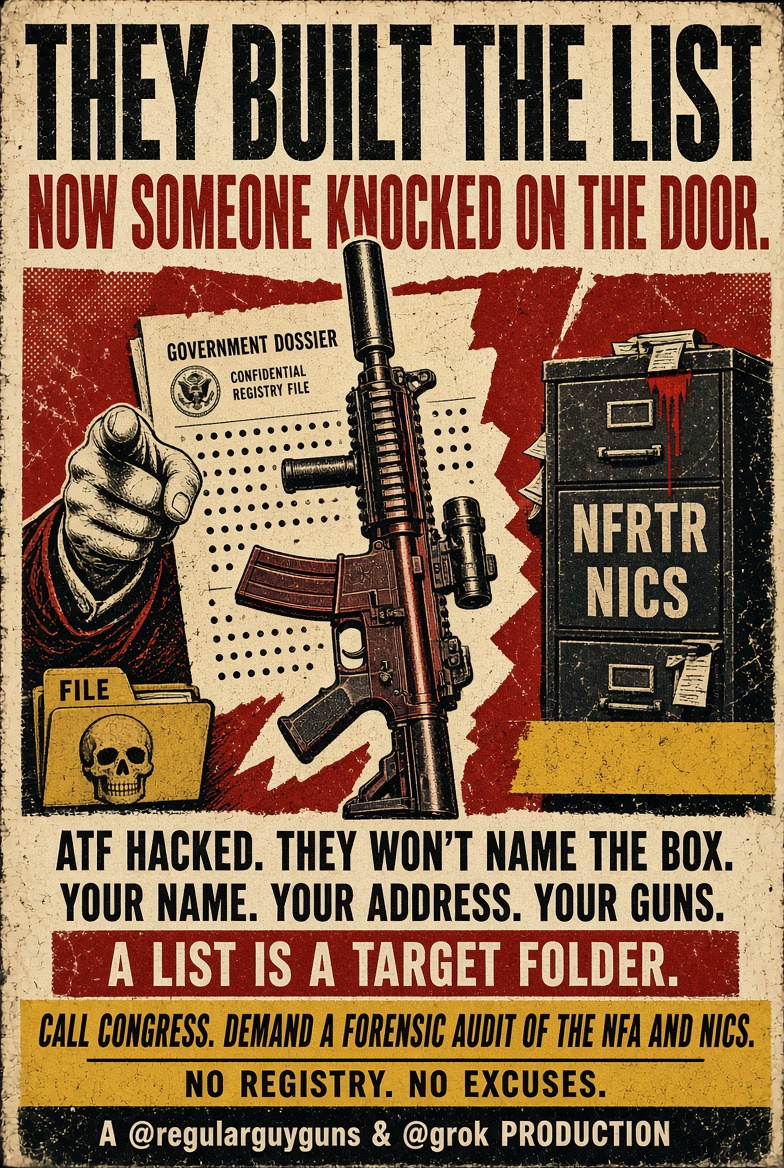
Demand a full, independent forensic audit of the NFA systems and of the NICS systems and processes — not an ATF pamphlet, not an FBI slide deck, and not another “no indication” sentence. That means the NFRTR and the National Firearms Act application stack, eForms, out-of-business record imaging, multiple-sales files, inspection caches, and every interface those systems share with NICS: check logs, delay files, deny referrals, retention rules, and who can query what. Name the environment that got hit in August 2026. Publish dwell time. Publish data types. Swear, in writing, whether NFRTR, eForms, OBRIS, A2K, multiple-sales, NICS referral files, or any IOI inspection haul sat on the same identity plane. Then do the thing they will hate more than the breach itself: have an inspector general or an outside firm that does not report to the ATF Director say whether FOPA is being honored in practice or only in press releases.
Use the words 18 U.S.C. 926, independent forensic audit, NFA, and NICS in the same paragraph. If they hide behind “law enforcement sensitive,” tell them your home address is the sensitive part. If a candidate cannot say those four things out loud, they are not a Second Amendment candidate. They are a person who wants your vote and the list.
Ask every incumbent and every challenger, in writing:
- Will you demand and vote to fund a full forensic audit of ATF’s NFA systems and FBI/ATF NICS systems and processes after the August 2026 incident?
- Will you force a public count of digitized out-of-business 4473s and bound-book images — the number Congress has been begging for?
- Will you treat Jensen as the beginning of the NFRTR’s end, not a quirky Texas injunction?
- Will you defund the central digitization of dealer records into a searchable federal database?
- Will you support the abolition of the NFA, the NFRTR, and NICS, to be replaced with nothing?
Support the FOIAs. When GOA, FPC, and SAF ask for documents, fund the postage.
Join the organizations that do not negotiate the right away in conference rooms:
If you only have money for one dinner out this month, skip the dinner. Membership is cheaper than a lawyer after your name lands on a leak site.
Harden your own life without waiting for Martinsburg to grow a conscience. That does not mean a lecture on operational security theater. It means the obvious grown-up moves: minimize the commercial trail you do not need, keep your household legally tight, know your state’s law, train, and accept that the most important firewall in this country is still a free citizen who will not be a good victim.
The ATF wants this to be a one-day story about a box in a closet. It is not. It is the story of a government that built a list it was forbidden to build, kept that list on infrastructure it cannot defend, and now asks the people on the list to take its word for it.
Future is not a metaphor here. Lists get used. Leaks get sold. Administrations change. Foreign services do not take holidays. The men and women who think a registry is “common sense” will not be the ones standing in the doorway when the government takes off the mask and gives that all-encompassing ban order. Kris Brown won't be in the stack.
Act like your life is on the line. Because it is. Call them. Make them audit the NFA and NICS piles in public, or admit they prefer the dark. Also note who their corporate partners are. Accenture, Palantir, the tech bros. If a company's primary customer is the government, they are themselves de facto part of the government.
note: I wrote this with the aid of Grok. Let me know what you think. With Grok I can output faster, but it may not seem like "me" as much. Without Grok, you get "me" but slower.
Get Yourself A Gun And Learn It
This is a firearms blog, so we're going to recommend guns. Of course don't forget other things like medical, comms, doing your Area Study, and so on. There's better sources than RGG on those topics, but for firepower, we have you covered.
Ideally you'll at least want either a basic rifle, i.e. an AR-15, or a pistol, i.e. a GLOCK 19, to start. Both are exceedingly common firearms with plenty of accessories, spare parts, training, and support. However, in some restricted areas, both an AR and a GLOCK are hard to get easily, and you may have to settle for a shotgun for quickly arming yourself. It beats a sharp stick. Note, the in-house counsel wants to remind you that we're talking the legal acquisition of guns here. We're still working on abolishing gun control, and we don't want you in jail. Unfortunately you'll have to play ball in this regard. But anyways, here are some basic suggestions for getting armed.
| Firearm | Cost | Buy Now |
|---|---|---|
| Radical Firearms RF00028 AR-15 | $469 | Buy Now! |
| GLOCK 19 Gen6 9mm Pistol | $620 | Buy Now! |
| Mossberg 590 Shotgun | $621 | Buy Now! |
Learn how to make guns, as well.
| 3D Printer | Cost | Buy Now |
|---|---|---|
| Ender Creality 3 V3 SE | $186 | Buy Now! |
Support This Site
Operating Regular Guy Guns and bringing you quality content costs money, money that I am more than happy to spend, even after all these years! I get the occasional sponsor, but bills still have to be paid, ha ha.
You'll see the articles peppered with affiliate links. I get a few pennies when you make your purchases via my links.
-
Buy more guns at Palmetto State Armory
-
Buy more guns at Bear Creek Arsenal
-
Buy more guns at Brownells
TODO
Broken links in old articles
Addendums to old stuff
Buy more guns and make more guns
Podcast? AI killed the podcast.
Donate Bitcoin: 36wKfH7wgQQna6BByvAe8oiEmdqREUXuYQ